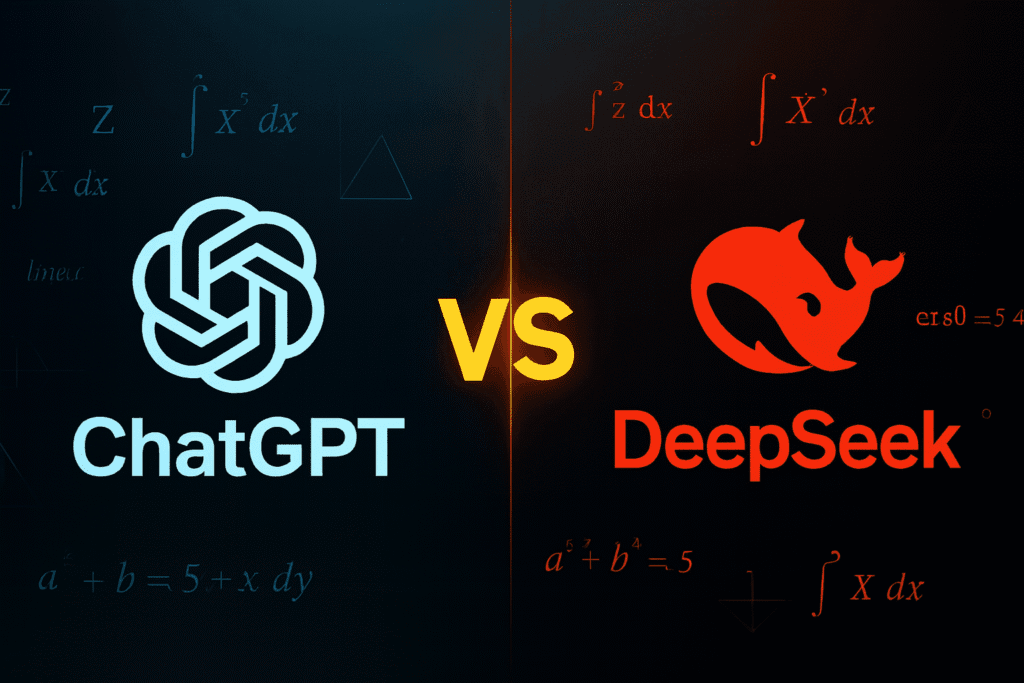
The artificial intelligence landscape has become increasingly competitive, especially when it comes to mathematical problem-solving. As students, professionals, and researchers seek reliable AI assistants for mathematical tasks, two names consistently emerge: ChatGPT and DeepSeek. But which one actually performs better when you’re stuck on a calculus problem at midnight or need help with statistical analysis?
This question isn’t just academic curiosity—it affects real decisions about which tool to use for homework, research, or professional work. Let’s dive deep into this mathematical showdown and find out which AI truly deserves the title of math champion.
Understanding the AI Math Battle
Why does it matter which AI is better at math? Think about it this way: mathematics is the universal language of logic, science, and technology. An AI that excels at mathematical reasoning doesn’t just solve equations—it demonstrates genuine problem-solving capabilities that extend to countless real-world applications.
The competition between ChatGPT (developed by OpenAI) and DeepSeek (created by the Chinese AI company DeepSeek) represents more than just corporate rivalry. It reflects different philosophies in AI development, training methodologies, and approaches to reasoning tasks. Understanding these differences helps us make informed choices about which tool serves our needs best.
What Makes an AI Good at Mathematics?
Before we compare these two powerhouses, we need to understand what separates exceptional mathematical AI from mediocre ones. It’s not just about getting the right answer—it’s about how they arrive at that answer.
Reasoning Capabilities
The hallmark of strong mathematical AI lies in its ability to break down complex problems into manageable steps. Can the AI explain why a particular approach works? Does it recognize when a problem requires algebraic manipulation versus calculus? These reasoning skills separate truly capable systems from glorified calculators.
Mathematical reasoning also involves pattern recognition, understanding mathematical notation across different formats, and applying appropriate theorems or formulas. The best AI systems demonstrate mathematical intuition that mirrors how human mathematicians think through problems.
Problem-Solving Approaches
Great mathematical AI doesn’t just memorize formulas—it understands when and how to apply different problem-solving strategies. This includes recognizing problem types, selecting appropriate methods, and verifying solutions for reasonableness. The AI should also handle ambiguous problems, ask clarifying questions when needed, and provide multiple solution paths when applicable.
ChatGPT’s Mathematical Strengths
ChatGPT, particularly its GPT-4 iteration, has gained widespread recognition for its versatility across numerous domains, including mathematics. But what specifically makes it a contender in the math arena?
GPT-4’s Architecture and Math Performance
OpenAI designed GPT-4 with enhanced reasoning capabilities that significantly improved upon its predecessors. The model underwent extensive training on mathematical texts, problem sets, and solution explanations. This training enables ChatGPT to handle everything from basic arithmetic to complex calculus problems.
One of ChatGPT’s notable strengths is its ability to explain mathematical concepts in accessible language. It doesn’t just spit out answers—it walks you through the logic, making it particularly valuable for educational purposes. The conversational interface allows users to ask follow-up questions, request clarification, or explore alternative solution methods.
Real-World Math Applications
ChatGPT excels at translating word problems into mathematical expressions, a skill that often challenges both students and AI systems. It understands context, can interpret ambiguous phrasing, and applies mathematical thinking to practical scenarios. Whether you’re calculating compound interest, analyzing statistical data, or working through physics problems, ChatGPT provides reliable assistance.
The system also handles mathematical notation well, interpreting various formats and conventions. It can work with LaTeX, standard notation, and even somewhat informal mathematical expressions that humans commonly use.
DeepSeek’s Competitive Edge
DeepSeek might be less familiar to Western users, but this Chinese AI model has been making serious waves in mathematical performance. Recent evaluations suggest that DeepSeek, particularly its V3 model, punches significantly above its weight class.
DeepSeek-V3’s Specialized Training
DeepSeek’s developers took a focused approach to mathematical capabilities, incorporating specialized training techniques that emphasize logical reasoning and step-by-step problem-solving. The model demonstrates particular strength in structured mathematical thinking, often showing more consistent performance across different problem types.
What sets DeepSeek apart is its apparent efficiency—it achieves competitive or superior results while reportedly using fewer computational resources than some competitors. This efficiency doesn’t come at the expense of accuracy; in fact, DeepSeek often matches or exceeds larger models in mathematical benchmarks.
Performance on Mathematical Benchmarks
Independent testing on mathematical benchmarks has revealed DeepSeek’s impressive capabilities. The model performs exceptionally well on standardized mathematical tests, including problems requiring multi-step reasoning and complex algebraic manipulation. It shows particular strength in maintaining logical consistency throughout lengthy solutions.
DeepSeek’s approach to verification—checking its own work and identifying potential errors—demonstrates a level of mathematical maturity that users find valuable. This self-correcting tendency reduces the likelihood of propagating errors through multi-step problems.
Head-to-Head Comparison
Now for the moment you’ve been waiting for: how do these systems actually compare when solving real mathematical problems?
Algebra and Calculus
In basic algebra, both ChatGPT and DeepSeek perform admirably. They handle equation solving, factoring, and symbolic manipulation with high accuracy. However, subtle differences emerge in more complex scenarios.
When tackling calculus problems, ChatGPT tends to provide more detailed explanations of concepts like limits, derivatives, and integrals. It’s excellent at teaching why certain rules apply. DeepSeek, meanwhile, often produces more concise solutions with cleaner mathematical notation, though sometimes with less pedagogical context.
For integration problems requiring substitution or parts, both systems demonstrate competence, though user reports suggest DeepSeek maintains slightly higher consistency with complex integrals.
Word Problems and Applied Math
This category represents a crucial test of practical mathematical ability. Word problems require understanding context, extracting relevant information, and formulating appropriate mathematical models.
ChatGPT shines here due to its superior natural language understanding. It parses complex verbal descriptions effectively and translates them into mathematical frameworks. The model also asks clarifying questions when problem statements are ambiguous—a valuable feature for real-world applications.
DeepSeek handles word problems competently but occasionally struggles with nuanced language or culturally specific contexts. However, once the problem is clearly defined mathematically, its solution accuracy matches or exceeds ChatGPT’s.
Advanced Mathematics
In advanced topics like linear algebra, differential equations, and abstract algebra, both systems demonstrate impressive capabilities with some important distinctions.
ChatGPT handles these topics with strong conceptual explanations, making it valuable for learning and understanding theoretical foundations. It connects mathematical concepts to broader themes and provides context that enriches understanding.
DeepSeek demonstrates particular strength in computational aspects of advanced mathematics. For matrix operations, eigenvalue calculations, and solving differential equations, DeepSeek often produces accurate results more consistently. The model seems to maintain better numerical precision in calculations involving complex numbers or large matrices.
Which One Should You Choose?
The “better” choice depends entirely on your specific needs and use case. Let’s break this down practically.
For Students and Educators
If you’re learning mathematics or teaching it, ChatGPT generally offers more value. Its explanatory capabilities, patient tone, and ability to present multiple approaches make it an excellent educational companion. The system adapts its explanations to different skill levels and provides the conceptual understanding that supports long-term learning.
ChatGPT’s conversational interface encourages exploration and questioning—essential elements of mathematical education. Students can develop deeper understanding through dialogue rather than simply receiving answers.
For Professionals and Researchers
Professionals working with mathematical models, data analysis, or technical calculations might find DeepSeek more efficient. Its concise, accurate solutions get straight to the point without excessive explanation. The model’s strong performance on complex calculations and its consistency across problem types make it reliable for professional applications.
However, ChatGPT’s integration with various platforms and its broader availability might make it more practical for many professional settings. The choice often comes down to accessibility and specific workflow requirements.
The Future of AI in Mathematics
The competition between ChatGPT and DeepSeek represents just the beginning of AI’s mathematical evolution. Both systems continue improving through updates and refinements, and the gap between them narrows with each iteration.
Future developments will likely focus on formal proof verification, handling of truly advanced mathematical research, and even discovering new mathematical relationships. As these AI systems improve, they’ll transition from tools that solve problems we already know how to solve into genuine collaborators in mathematical exploration.
The question isn’t whether AI will replace human mathematicians—it won’t. Instead, these tools will augment human mathematical capability, handling tedious calculations while humans focus on creative problem-formulation and intuitive leaps that still elude artificial intelligence.
Conclusion
So, is ChatGPT or DeepSeek better at math? The answer isn’t black and white. ChatGPT excels at explanation, teaching, and contextual understanding, making it ideal for learning and exploring mathematical concepts. DeepSeek demonstrates superior consistency in pure calculation and computational mathematics, serving professionals who need accurate, efficient solutions.
For most users, ChatGPT’s accessibility, explanatory prowess, and versatility make it the practical choice. However, those seeking maximum computational accuracy or working with specific advanced mathematical problems might find DeepSeek’s focused capabilities more aligned with their needs.
Ultimately, both systems represent remarkable achievements in artificial intelligence. Rather than declaring a definitive winner, recognize that having multiple strong options benefits everyone. Try both systems with your specific mathematical challenges—you might find that different tools serve different purposes in your mathematical toolkit.