Samsung just posted one of the best quarters in its history — and Wall Street shrugged. Nasdaq futures slid on Tuesday as chip stocks took a beating, proof that even record numbers can’t quiet doubts about how much further the AI trade has to run. The tech-heavy index dipped in premarket trading, and SpaceX shares dropped too, right before the company’s long-awaited Nasdaq-100 debut.
Elon Musk’s SpaceX finally began trading as part of the Nasdaq-100 index on Tuesday. A pack of brokerages jumped in with fresh coverage the moment the stock’s industry-mandated quiet period lifted, each rushing out notes and price targets on a company that barely needs the introduction. You’d think that much attention would give the shares a lift. Instead, SpaceX fell 1.7% in premarket trading — a small but telling sign that this market isn’t in a forgiving mood right now, no matter how big the name is or how much buzz surrounds it.
The real damage, though, was in chips. Memory chipmaker Micron Technology dropped 5.6%, Western Digital lost 6.2%, and Sandisk fell 5.2%. It didn’t stop there. Intel slid 4%, Marvell Technology gave up 4.5%, and Qualcomm dropped 2.4% as the selling spread across the whole sector, hitting names that had nothing directly to do with Samsung’s earnings. Richard Hunter, head of markets at interactive investor, put it plainly: the question now isn’t whether AI demand is weak. It’s whether the eye-watering sums already poured into AI investment can actually pay for themselves over time. “The wider issue is whether this is a new chapter for investor reaction,” Hunter said, pointing to the trillions of dollars hyperscalers have funneled into the buildout so far.
That’s the tension running under this whole rally. Chip stocks have been some of the biggest winners of the AI trade all year, riding hopes of demand that never seems to run out. But lately, that story has started to wobble, and even strong earnings aren’t enough to settle nerves. Traders are worried the sector got overbought, and plenty are simply cashing in gains while they can — hence the volatility that’s crept back in over recent sessions. Another gut-check arrives later this week, when South Korean chipmaker SK Hynix lists in the U.S. and starts trading on the Nasdaq. How that debut goes will say a lot about whether investors still have an appetite for chip names, or whether they’re quietly pulling back for good.
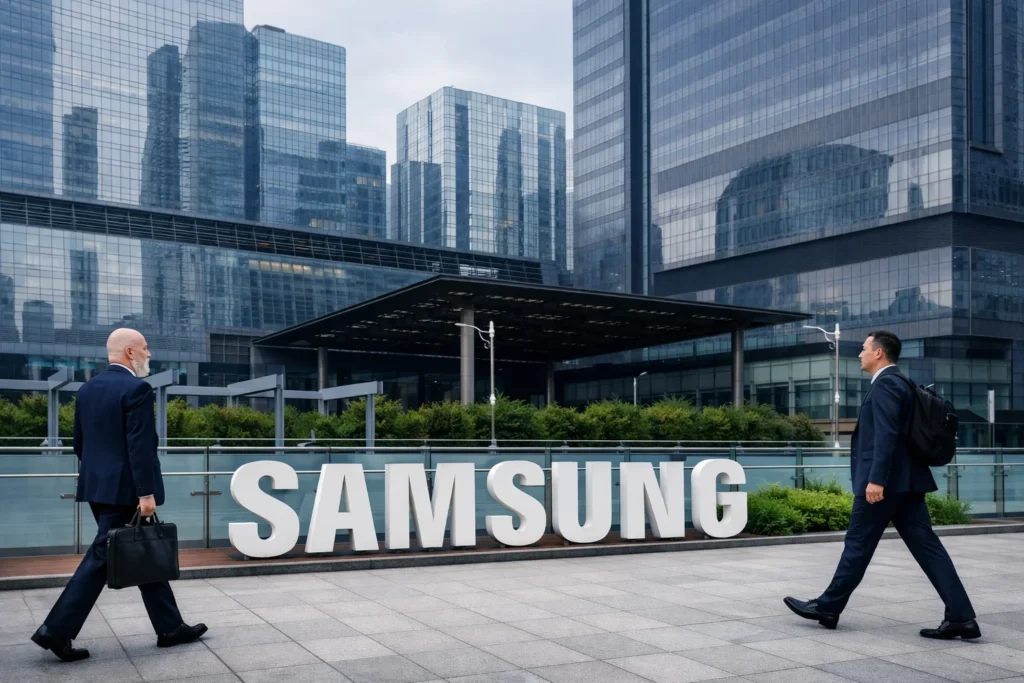
Which brings us back to Samsung. Samsung Electronics reported an operating profit so large it topped its combined earnings from the past three years — and its shares still sank in South Korea. That’s not a small detail. It suggests investors have stopped rewarding companies just for beating expectations once. They want to see that this level of earnings sticks around, not just that it showed up for a single quarter, and that’s a much harder bar to clear.
Elsewhere on the board, the mood was mixed rather than uniformly bad. At 04:56 a.m. ET, Dow E-minis were up 86 points, or 0.16%, while S&P 500 E-minis slipped 11.75 points, or 0.15%. Nasdaq 100 E-minis, meanwhile, were down a much steeper 270.75 points, or 0.9% — a gap that shows how concentrated the pain really was in tech, rather than spread evenly across the broader market. Dow futures held up thanks to software names Microsoft, Salesforce, and IBM, which all moved higher and offset some of the tech-sector drag. That strength helped the blue-chip index punch past the 53,000-point mark for the first time on Monday, its fifth 1,000-point milestone this year. Easing Middle East tensions and receding oil prices have quietly been giving the broader market some extra support too, even as chip stocks stole most of the attention.
Morgan Stanley weighed in with a note dated Monday, arguing that the recent weakness in U.S. semiconductor stocks isn’t a red flag so much as a rotation. Market gains are broadening out, the bank said, with investors likely to turn toward AI hyperscalers rather than chase pure chipmakers at current prices. That showed up almost immediately: most megacap and growth stocks traded higher Tuesday, even as Tesla and Nvidia each slipped around 1%. Money isn’t leaving the AI trade — it’s just moving to different corners of it, and that distinction matters for anyone watching the sector closely.
A few other names stood out for reasons that had nothing to do with chips. Fiserv climbed 7.1% on media reports that the payments firm has been in talks with U.S. banks, including JP Morgan and Bank of America, about selling off its payments infrastructure business, the one that handles debit card transactions. Rivian went the other way, dropping 7.6% after the electric-vehicle maker launched an offer to sell 75 million shares — even though it forecast second-quarter revenue above analysts’ estimates. A strong forecast, in other words, doesn’t always save a stock from a rough trading day.
There’s a bigger backdrop to all of this too. U.S. Federal Reserve watchers are waiting on Wednesday, when the central bank releases minutes from its last meeting — the first under new Chair Kevin Warsh’s tenure. Traders are currently pricing in at least one 25-basis-point rate hike this year, according to data compiled by LSEG. That single data point could end up shaping how markets read everything else this week, chip stocks very much included.