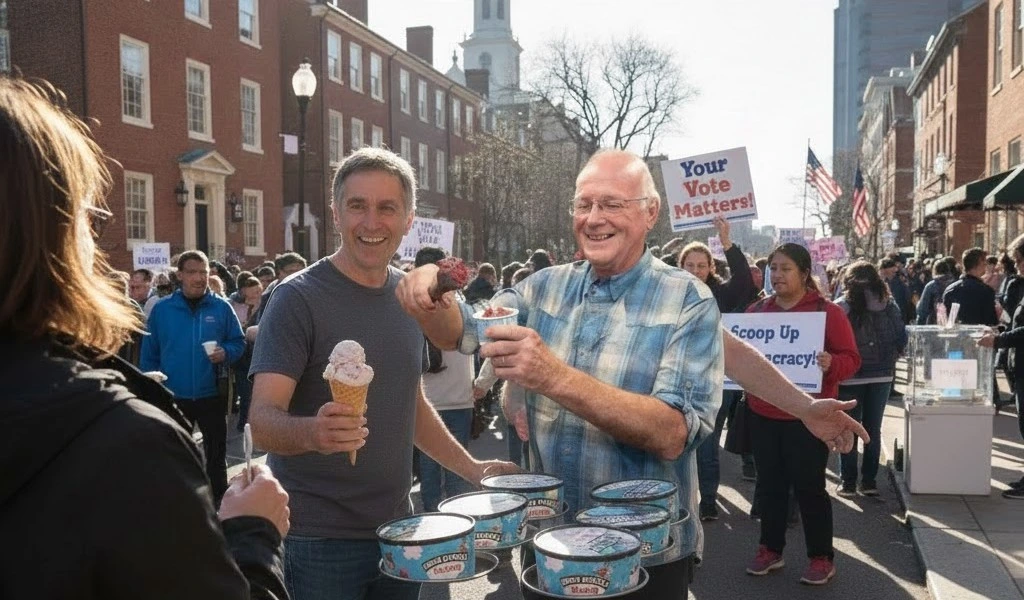
Ben & Jerry’s brand faces potential destruction under its parent company Magnum, warns co-founder Ben Cohen in stark comments to the electronic media. The warning comes as Magnum Ice Cream Company began trading on the European stock market following its spin off from Unilever, intensifying a long-running spat over the Vermont-based ice cream brand’s social activism and board independence.
The conflict between Ben & Jerry’s and its corporate owners has reached a critical point. Mr Cohen told the media he feared the brand would become “just another piece of frozen mush” that would lose significant market share. His remarks highlight deepening clashes that began when the company was sold to Unilever in 2000 under a deal that allowed the ice cream brand to retain an independent board and the right to make decisions about its social mission.
The business arrangement, designed to protect the brand’s values-based position in the world, now appears threatened. Ben Cohen, who remains an employee and high-profile spokesperson for the brand, warns that Magnum ownership will destroy what makes Ben & Jerry’s special. The firm’s loyal followers, he says, will be lost for good if the company continues under current ownership.
The conflict escalated last month when Magnum declared that chair Anuradha Mittal, who has held the position since 2018, “no longer meets the criteria to serve”. A spokesperson for Magnum cited an internal audit that found “a series of material deficiencies in financial controls, governance and other compliance policies, including conflicts of interest”. The firm claims trustees have not fully addressed the deficiencies identified.
Ms Mittal fought back in a statement to electronic media, calling the audit a “manufactured inquiry – engineered to attempt to discredit” her. She argues this represents “Unilever’s attempt to undermine the authority of the Board itself”, not simply an attack on her leadership. Mr Cohen supports this view, insisting Magnum “has no standing to determine who the chair of the independent board should be”.
The brand’s ability to express its social activism has become a flashpoint. In 2021, Ben & Jerry’s refused to sell products in areas occupied by Israel, resulting in its Israeli operation being sold by Unilever to a local licensee. Last October, Ben Cohen said the brand was prevented from launching an ice cream expressing “solidarity with Palestine”.
This stifling of the social mission drove Jerry Greenfield, Mr Cohen’s fellow founder, to left the company in September after almost half a century at the firm. He cited concerns about restrictions on the brand’s values. The founders, now in their seventies, face pressure from new ownership to hand over to a “new generation”, according to Magnum chief executive Peter ter Kulve, who spoke to the Financial Times on Sunday.
The Financial Stakes
Investors in Magnum are being asked to pay a premium for Ben & Jerry’s precisely because it has “such a loyal following”, Mr Cohen points out. Yet he warns that as Magnum destroys the brand’s values, it will destroy that following. The demerger of Unilever’s ice cream business saw primary shares in TMICC (Magnum Ice Cream Company) open at €12.20 (£10.66) on the EuroNext exchange in Amsterdam – below the expected €12.80 (£11.18) reference price. Shares bounced back by 1.3% at close of trading, making Magnum the world’s biggest standalone ice cream business.
A spokesperson for Magnum insists Ben & Jerry’s is “not for sale” and claims the firm has “always respected” the brand’s commitment to continue its social mission. The company wants to build and strengthen the brand’s “powerful, non-partisan values-based position”. Yet Mr Cohen demands either a “180 degree turn” in Magnum’s approach or for the business to be “owned by a group of investors that support the brand and want to encourage the values”.
What Happens Next
Ms Mittal, according to news agency, has no plans to step down from her role as chairman of the independent board. Mr Cohen argues that by trying to change the board leadership, Magnum proves it is “not fit to own Ben & Jerry’s“. The legally binding agreement from the 2000 sale should protect the brand’s independence, he insists, calling Magnum’s actions “absurd”.
The conflict inherited from Unilever now threatens to undermine what has made Ben & Jerry’s distinctive since its founding. Whether Magnum can understand the value of the brand’s essence – or whether it will indeed become another piece of frozen mush – remains the central question as this corporate battle unfolds on the day TMICC joined the European stock market.