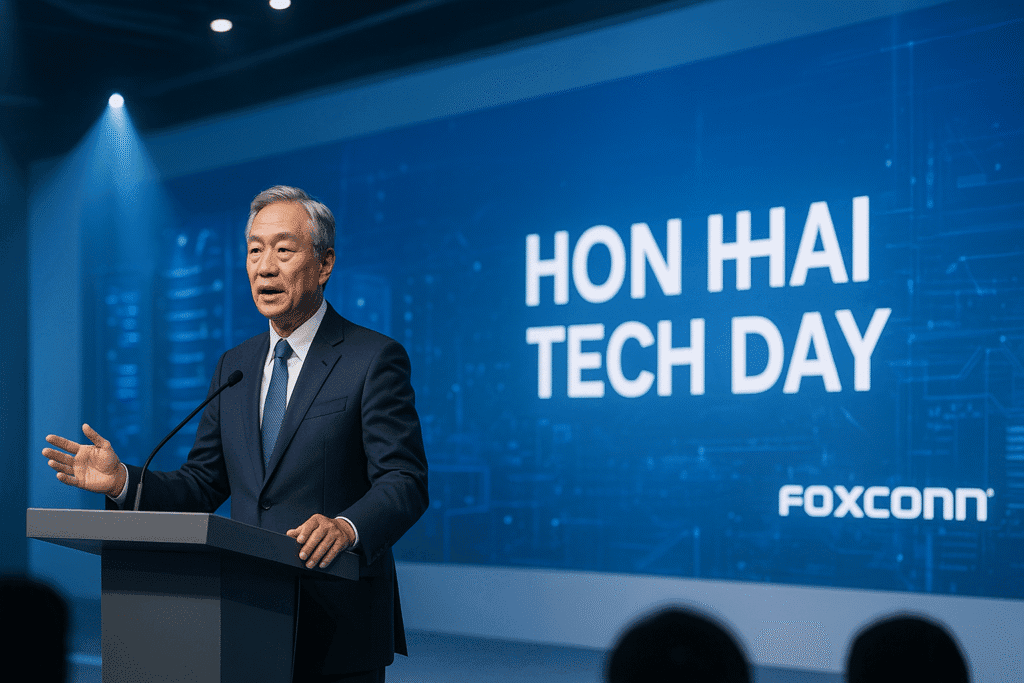
Foxconn shocked Wall Street Wednesday when it announced third-quarter profit jumped 17% compared to a year earlier. The world’s largest contract electronics maker pulled in net profit of NT$57.67 billion, crushing what analysts thought was possible at NT$50.41 billion. What’s fueling this surge? Simple: everyone wants AI servers, and Foxconn knows how to build them.
Here’s what makes this quarterly report interesting. Revenue hit 2.06 trillion New Taiwan dollars (that’s $66.29 billion for those counting), landing right where LSEG SmartEstimates said it would at NT$2.06 trillion expected. But profit? That’s where things get exciting. The company beat expectations by a solid margin, proving its bet on artificial intelligence server business wasn’t just corporate talk.
Foxconn, or Hon Hai Precision Industry if you’re reading official documents, isn’t the same company it was five years ago. Sure, it’s still the best known outfit for building Apple’s iPhones—that’s the world’s largest manufacturer of those devices. But the real money lately comes from somewhere else entirely. The firm manufactures server racks designed specifically for AI workloads, making it a key partner to Nvidia, the American AI chip darling everyone’s talking about.
This shifting of business avenues represents a calculated gamble. You don’t just wake up one morning and decide to chase AI money. But when you’re leveraging your dominance in contract manufacturing, you can secure both current and future orders from companies desperate to build data centers.
The numbers tell a clear story. Foxconn’s Cloud and Networking segment posted strong year-on-year growth, all supported by massive demand for AI server racks. And this isn’t slowing down. The company expects operations during the second half of the year—traditionally the peak season for electronics—to maintain continuous quarterly growth. They’re citing stronger AI server shipments alongside rising demand for standard information and communications technology products.
“Foxconn’s server manufacturing business is currently in a strong growth phase, underpinned by robust demand,” said Ivan Lam, senior analyst at Counterpoint Research, in an interview with Media. Lam points out something fascinating about Foxconn’s approach: they’re playing what he calls a “follow the cash” strategy that involves sacrificing some consumer electronics orders to chase bigger margins elsewhere.
Think about that for a second. Foxconn built its empire assembling phones and laptops. Now they’re deliberately trading parts of that consumer electronics footprint for longer-term momentum in servers. It’s not every day you see a manufacturing giant willingly walk away from steady business, but the AI boom makes that decision look smart.
Nothing’s perfect, though. Foxconn cautioned that global political and economic uncertainty could throw wrenches into plans. Exchange rate fluctuations remain unpredictable, requiring continued close monitoring from management. Then there’s the operational headaches: component price volatility, currency swings, and logistics challenges all pressure margins in ways that keep executives up at night.
Still, Lam thinks Foxconn’s fourth-quarter results should remain favorable. Why? The electronics contract manufacturer has positioned itself at the center of multiple tech trends simultaneously. During the September quarter, management demonstrated they could navigate these challenges while still delivering for shareholders.
The pivot toward high-growth server manufacturing is clearly paying off, according to industry watchers. This isn’t just about one good quarter. Foxconn is building something sustainable, even as they face component price volatility and other operational pressures that come with massive scale manufacturing.
Here’s where things get interesting. Foxconn isn’t just partnering with Nvidia on AI servers. They’re also working with Stellantis and Uber to build “Level 4” autonomous vehicles—the kind that don’t require a safety driver to be present behind the wheel. That’s not a small side project. That’s betting on another revolutionary technology before the market fully materializes.
This diversification makes sense when you think about Foxconn’s core competency. They’re masters at taking complex technology and figuring out how to manufacture it at scale. Whether that’s phones, servers, or self-driving cars doesn’t really matter. The strategy remains consistent: identify emerging tech, become the manufacturing partner of choice, lock in current and future orders before competitors catch up.
Recently, on Nov. 6, Foxconn signed a memorandum of understanding with Mitsubishi Electric to jointly supply energy-efficient AI data center solutions globally. This partnership goes beyond simple component supply. Besides AI data centers, the two companies plan to explore additional new business models and solutions using their combined technological and knowledge capabilities.
What does this tell us? Foxconn sees the AI demand wave as more than temporary hype. They’re investing in relationships and capabilities that position them for sustained growth regardless of which specific AI applications take off. The company reported strong performance in its traditional peak season, but management clearly believes the AI opportunity extends far beyond typical seasonal patterns.
The driven growth in artificial intelligence server business reflects broader industry trends. As companies race to deploy AI capabilities, they need infrastructure fast. Foxconn’s manufacturing expertise, built over decades assembling consumer electronics, translates perfectly to this new challenge. They’re not learning manufacturing from scratch—they’re applying proven capabilities to AI workloads that require similar precision and scale.