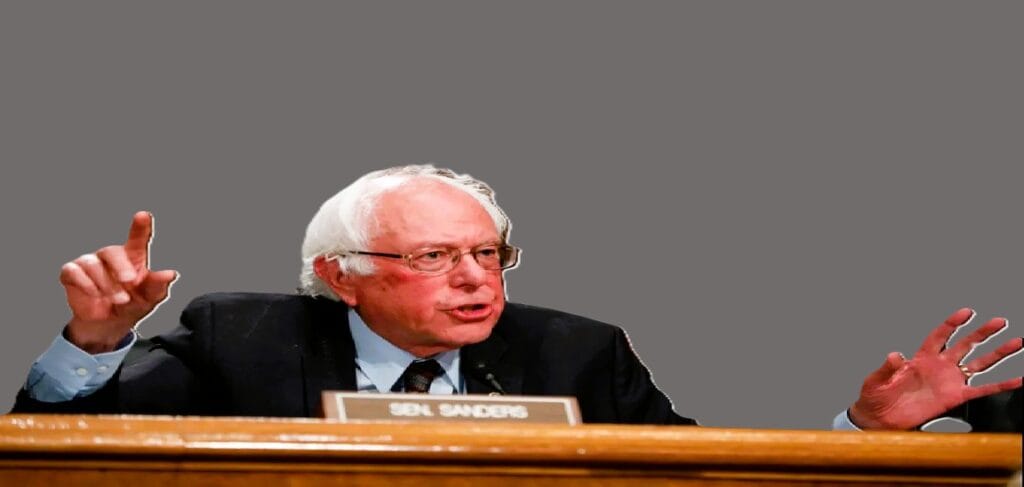
Sen. Bernie Sanders (I-Vt.) believes the government should break up OpenAI, warning that artificial intelligence poses threats far beyond market competition. The Vermont senator told Axios that splitting the ChatGPT maker represents just one step in addressing what he described as a “meteor coming” toward America’s economy and social fabric.
Bernie Sanders didn’t mince words when journalist Alex Thompson asked whether OpenAI needed to be split up during an interview released Friday. “I do, but it’s a deeper issue than that,” the senator said, urging Americans to “take a deep breath” before the transformational impact reshapes everything you know about work and relationships. His concerns extend beyond typical antitrust arguments, focusing instead on the potential impact of AI as a meteor coming that requires urgent preparation.
The call for dissolution of the technology company marks a significant escalation in political scrutiny of Artificial Intelligence (AI) development. Sanders emphasized that complexity management demands more than traditional regulatory action—it requires rethinking how tech moguls shape America’s future without regard for working class people.
The economic disruption from AI could trigger massive job loss across multiple sectors, Sanders voiced in stark terms. “I want to see us rebuilding manufacturing in America, but it ain’t gonna do any worker any good if that manufacturing work is done by robots,” he explained. Entry level jobs face particular risk as automation and robotics eliminate opportunities for younger people trying to enter the workforce.
Labor displacement threatens not just factory floors but office jobs too. Predictions from Anthropic CEO Dario Amodei suggest AI could wipe out a large portion of entry-level white-collar jobs in the next few years. Yet experts have underscored that jobs data has yet to show concrete effects, leaving economic analysis and workforce trends reliant on forecasts rather than empirical evidence.
Sanders targeted Elon Musk, Jeff Bezos, and Larry Ellison by name, calling them the “richest guys” who are investing huge amounts of capital in AI and robotics. “If you think they give a damn about the needs of working class people, you would be mistaken,” he continued. The Vermont senator connected tech investment by billionaires directly to wealth concentration and income inequality.
Corporate interests drive innovation without considering worker protection or labor rights, Sanders argued. These tech moguls pursue technological unemployment through labor automation while workers lose employment opportunities in both the manufacturing sector and service sector. The class divide widens as venture capital flows toward workplace disruption rather than job creation or business development supporting small businesses and entrepreneurship.
Beyond employment, Sanders warned about products being sold as replacements for genuine human connection. “You don’t need to relate to a human being anymore. You will have somebody hanging around your neck as your AI buddy,” he said, describing artificial companion technology. His comments appear to allude to Friend, a wearable AI companion whose advertising campaign in the New York subway has drawn scrutiny and sparked conversations about social relationships.
In a country experiencing a lot of emotional distress, the psychological impact of companion technology raises serious questions about mental health and how humans relate to each other. Sanders added that isolation and technology dependence threaten interpersonal connections and social connection at a time when emotional wellbeing requires more human relationships, not fewer. The future of AI involves not just economic impact but profound social impact on how human beings form bonds.
Sanders separately expressed concerns about superintelligent AI technology that surpasses human intelligence. Several prominent figures including AI pioneers Yoshua Bengio and Geoffrey Hinton, plus Apple co-founder Steve Wozniak, recently signed onto a statement calling for a ban on superintelligence development until there’s broad scientific consensus it can be done safely and controllably.
The existential risk from AGI (artificial general intelligence) adds another dimension to debates about AI safety and responsible AI. These tech giant leaders advocate for a comprehensive approach to AI ethics and regulation, recognizing that safety concerns demand policy intervention before transformational technology reshapes society irreversibly. Government regulation must address both immediate market competition and monopoly concerns while considering broader implications for societal change.
Washington Faces Pressure on Tech Regulation
The urgency surrounding AI regulation grows as lawmakers confront systemic issues requiring complexity far beyond traditional company breakup strategies. Sanders frames OpenAI as emblematic of tech regulation challenges where innovation and disruption proceed faster than policy intervention. His analogy comparing AI to a “meteor coming” captures the transformational change barreling toward the United States economy.
Market analysis suggests technology dependence will only deepen across sectors, making preparation and deal-making with industry increasingly difficult. The job market faces workforce impact while employment data lags behind reality, leaving workers vulnerable to labor displacement without adequate worker protection. Whether through antitrust action, dissolution, or new frameworks for government regulation, Washington must act before AI’s potential impact on employment opportunities, creativity, and economic development becomes irreversible. The meteor metaphor isn’t hyperbole—it’s a warning that time for comprehensive approach to AI governance is running out.