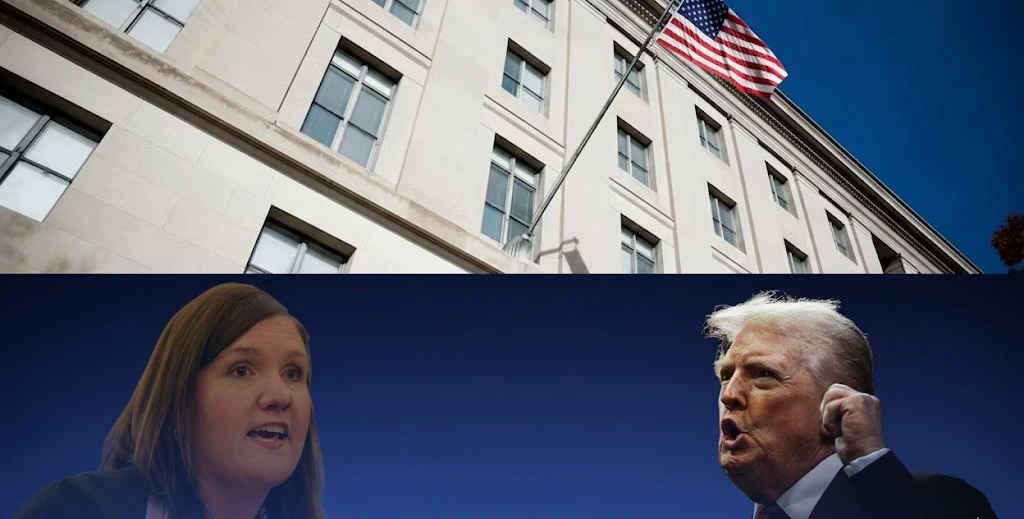
The U.S. Supreme Court prepares to hear arguments on Monday examining the legality of Donald Trump’s firing of Federal Trade Commission member Rebecca Slaughter, testing presidential power and threatening a 90-year-old legal precedent that has shielded independent agencies from political interference since 1935.
This case gives the court’s 6-3 conservative majority an opportunity to overturn the New Deal-era Humphrey’s Executor v. United States decision, which established that presidents cannot remove commissioners from certain government entities without cause. The Justice Department’s appeal challenges a lower court decision that found the Republican president exceeded his authority when he moved to dismiss the Democratic FTC member in March before her term was set to expire in 2029.
What the Case Means for Executive Power
Trump’s administration is embracing the unitary executive theory, a conservative legal doctrine that argues the president should possess sole authority over the entire executive branch. This includes the power to fire and replace heads of independent agencies at will, despite tenure-protected terms given by Congress. Lawyers representing the administration have advanced arguments that the modern FTC “indisputably wields executive power,” bolstering their case that its members can be fired for policy differences rather than just cause like inefficiency, neglect of duty, or malfeasance in office.
A 1914 law passed by Congress permits a president to remove FTC commissioners only for specific reasons, not political disagreements. Similar protections cover officials at more than two dozen other agencies, including the National Labor Relations Board and Merit Systems Protection Board, keeping these offices free from presidential meddling.
How Lower Courts Ruled on the Firing
Washington-based U.S. District Judge Loren AliKhan in July blocked Trump’s firing of Slaughter, rejecting the administration’s argument that tenure protections unlawfully encroached on presidential power. The U.S. Court of Appeals for the District of Columbia Circuit in September issued a 2-1 decision that kept the ruling in place, finding the statutory protections shielding FTC members from being removed without cause comply with the Constitution in light of the Humphrey’s Executor precedent.
However, the Supreme Court later in September allowed Trump’s ouster of Slaughter to go into effect—an action that drew dissents from its three liberal justices—while agreeing to hear the full case. This means Slaughter has already been removed from her position at the consumer protection and antitrust agency, even as the legal battle continues.
The 1935 Precedent Under Threat
The 1935 decision in Humphrey’s Executor v. United States rebuffed Democratic President Franklin Roosevelt’s attempt to fire a Federal Trade Commission member over policy differences. The court said restricting a president’s removal of commissioners was lawful because the FTC performed tasks more closely resembling legislative and judicial functions rather than those belonging squarely to the executive branch, which is headed by the president. The Constitution set up a separation of powers among the U.S. government’s coequal executive, legislative, and judicial branches.
In recent decades, the Supreme Court has narrowed the reach of Humphrey’s Executor but stopped short of overturning it. A 2020 ruling said Article II of the Constitution gives the president the general power to remove heads of agencies at will, but the 1935 precedent had carved out an exception that allowed for-cause removal protections for certain multi-member, expert agencies.
Why This Matters for Independent Agencies
Slaughter was one of two Democratic commissioners who Trump moved to fire from the FTC, drawing criticism from Democratic senators and antimonopoly groups concerned that the move was designed to eliminate opposition within the agency to big corporations. The firings raised questions about whether independent agencies can maintain their independence when a president disagrees with their regulatory and enforcement authority. Lawyers for Slaughter acknowledged that the FTC’s powers have grown since the original Humphrey’s Executor decision, but citing Supreme Court precedent, they argued that the constitutionality of removal restrictions does not hinge on the breadth of an agency’s powers.
This major test could imperil protections that have existed for nearly a century, affecting not just the FTC but dozens of other government entities with tenure-protected officials.
What Happens Next in Court
The case tests whether the court’s conservatives are willing to rein in or completely overturn the Humphrey’s Executor legal precedent. Slaughter’s case also gives the justices an opportunity to address whether lower courts are permitted to block the removal of executive officials even if such firings are found to have been illegal. The Supreme Court is expected to rule by the end of June, which will determine whether presidents can fire commissioners from independent agencies based on policy differences or whether Congress can continue restricting such removal to specific causes.
In a similar case involving presidential powers, the court will hear arguments on January 21 in Trump’s attempt to remove Federal Reserve Governor Lisa Cook, a move without precedent that challenges the central bank’s independence. Both cases represent unprecedented tests of how much authority a president possesses over government entities that Congress has tried to keep free from direct presidential control.