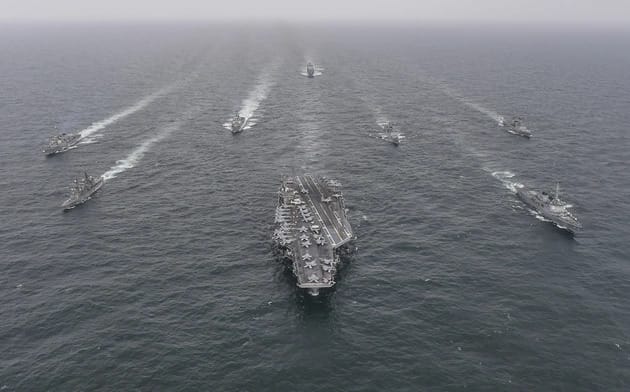
The Pentagon announced Friday that Defense Secretary Pete Hegseth has ordered the USS Gerald R. Ford and its strike group to deploy to South America, marking a major escalation of military power in the region. The aircraft carrier, currently in the Mediterranean Sea with three destroyers, will take several days for the journey to US Southern Command waters to “bolster US capacity to detect, monitor, and disrupt illicit actors and activities that compromise the safety and prosperity of the United States,” according to Pentagon spokesman Sean Parnell in a social media post.
This deployment represents an unusually large military buildup in the Caribbean Sea and the waters off Venezuela, raising questions about the Trump administration’s true intentions in the hemisphere. The move comes as the US military has conducted 10th strike operations against suspected drug-running boat targets, with the death count reaching 43 people since early September.
Deadly Strikes Intensify as Carrier Heads South
The pace of strikes has quickened dramatically in recent days, jumping from one every few weeks to three this week. The latest boat attack overnight left six people dead and was the first one conducted at night, according to Hegseth. The vessel was allegedly operated by the Tren de Aragua gang, a foreign terrorist organization that originated in a Venezuelan prison and has been designated by the Republican administration as being at the root of violence and drug dealing that plague American cities.
A 20-second black and white video of the strike shows a small boat sitting motionless on the water when a long thin projectile descends, triggering a massive explosion. The blast completely destroys the vessel in international waters off the coast of the region. “If you are a narco-terrorist smuggling drugs in our hemisphere, we will treat you like we treat Al-Qaeda,” Hegseth said, vowing to “map your networks, track your people, hunt you down, and kill you” whether it’s day or night.
Operations Expand into Eastern Pacific Ocean
The area of operations has been expanding and shifting toward the eastern Pacific Ocean, where much of the cocaine from the world’s largest producers is smuggled through maritime routes. At least four boats that have been hit originated from Venezuela, according to the administration. The strikes now cover vast waters across multiple zones, demonstrating the military’s presence and reach throughout the region.
The escalating military actions and the unusually large US military buildup have raised speculation that the administration could be preparing to topple Venezuelan President Nicolás Maduro, who faces charges of narcoterrorism in the United States. In the latest move Thursday, the US flew a pair of supersonic heavy bombers up to the coast of Venezuela in what analysts describe as a clear sending message to regional capitals.
Venezuela Prepares for Possible US Attack
Maduro argues that the operations are less about combating drug trafficking and more an effort to force him out of office. The Venezuelan President praised security forces and a civilian militia Thursday for conducting defense exercises along 2,000 kilometers (1,200 miles) of coastline to prepare for the possibility of a US attack. In a span of six hours, “100 percent of all the country’s coastline was covered in real time, with all the equipment and heavy weapons to defend all of Venezuela’s coasts if necessary,” Maduro said during a government event shown on state television.
Elizabeth Dickinson, senior analyst for the Andes region at the International Crisis Group, believes the military’s presence is about more than just drugs. “An expression that I’m hearing a lot is ‘Drugs are the excuse.’ And everyone knows that,” Dickinson said. “The message is very clear in regional capitals. The messaging here is that the US is intent on pursuing specific objectives. And it will use military force against leaders and countries that don’t fall in line with US interests.”
War on Terror Tactics Applied to Drug Cartels
Hegseth’s remarks around the strikes have recently begun to draw a direct comparison between the war on terrorism declared after the Sept. 11, 2001 attacks and the Trump administration’s crackdown on drug traffickers. President Donald Trump this month declared drug cartels to be unlawful combatants and said the US was in an “armed conflict” with them, relying on the same legal authority used by the Bush administration after 9/11.
When reporters asked Trump Thursday whether he would request Congress issue a declaration of war against the cartels, he said that wasn’t the plan. “I think we’re just going to kill people that are bringing drugs into our country, OK? We’re going to kill them, you know? They’re going to be like, dead,” Trump said during a roundtable at the White House with homeland security officials. The administration maintains it is targeting narco-terrorist networks that threaten American communities.
Lawmakers Divided Over Military Escalation
Lawmakers from both major political parties have expressed concerns about Trump ordering military actions without receiving authorization from Congress or providing details to elected officials. Democrats have insisted the strikes violate international law and represent an unprecedented use of force without proper oversight. “I’ve never seen anything quite like this before,” said Sen. Andy Kim, D-N.J., who previously worked at the Pentagon and State Department, including as an adviser in Afghanistan.
“We have no idea how far this is going, how this could potentially bring in, you know, is it going to be boots on the ground? Is it going to be escalatory in a way where we could see us get bogged down for a long time?” he added. However, Republican Rep. Mario Diaz-Balart of Florida, who has long been involved in foreign affairs in the hemisphere, supports the approach: “It’s about time.” The congressman said the president “obviously hates war” but is “not afraid” to use the US military in targeted operations. “I would not want to be in the shoes of any of these narco-cartels,” Diaz-Balart added.