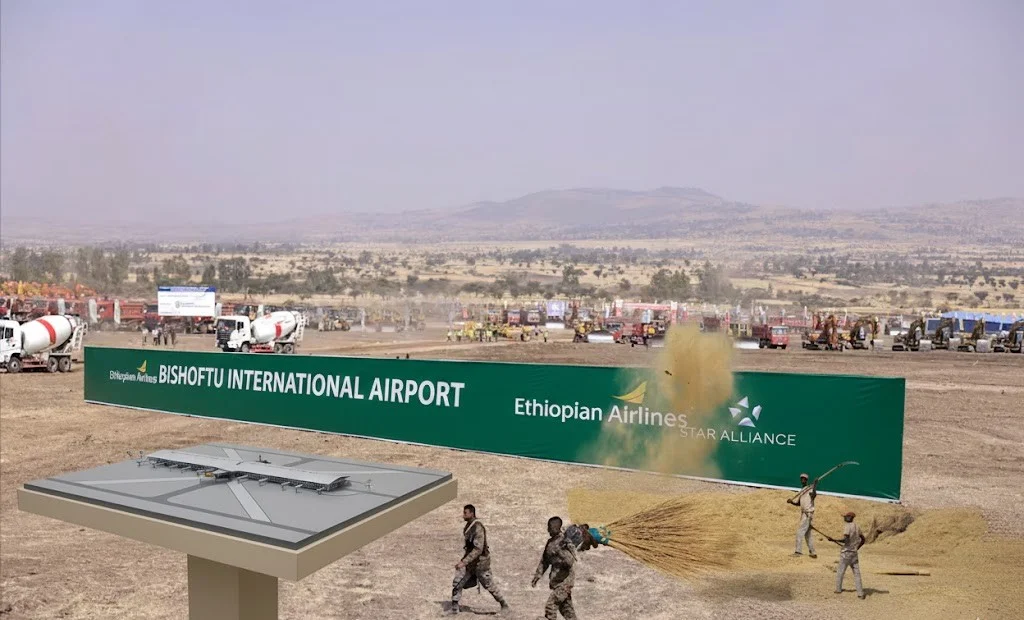
Ethiopian Airlines broke ground Saturday on a $12.5 billion airport in Bishoftu. Officials call it Africa’s biggest airport. When it opens in 2030, the facility will dwarf anything else on the continent—and that’s exactly what Ethiopia needs right now.
The state-owned carrier didn’t just win the contract to use this airport. It’s building the thing. The four-runway complex sits 45 km southeast of Addis Ababa, in the Ethiopian town of Bishoftu (about 28 miles if you’re counting). Prime Minister Abiy Ahmed Ali announced the construction project on X, describing it as “the largest aviation infrastructure project in Africa’s history.”
Here’s what that means in practice: space for 270 planes and capacity for 110 million passengers annually. Ethiopia’s current main airport? It handles maybe a quarter of that. Abiy warned it’ll hit maximum capacity within two or three years given existing traffic growth. You can already feel the squeeze if you’ve flown through Addis Ababa recently.
Abraham Tesfaye runs Infrastructure Development & Planning for the airline. He told reporters the funding split breaks down like this—Ethiopian Airlines covers 30%, lenders pick up the rest. The state-owned airline has already allocated $610 million just for earthworks. That phase wraps in one year, Tesfaye said at the site. Main contractors start in August 2026.
The price keeps climbing. Initially billed at $10 billion, the project now carries a $12.5 billion tag. Why? The scope expanded as planners added features and capacity. It happens with mega-projects (though taxpayers and lenders probably aren’t thrilled about the extra $2.5 billion).
Financing comes from everywhere. The African Development Bank pledged $500 million last August and committed to raising another $8.7 billion. “Lenders from Middle East, Europe, China and USA have shown strong interest to finance the project,” Abraham said. Translation: money isn’t the problem here. Everyone wants a piece of Africa’s aviation future.
Ethiopian Airlines operates as Africa’s biggest carrier, and the numbers show why this airport matters. Six extra international routes launched in 2024/25. Revenues keep expanding. The airline needs room to grow, and Addis Ababa’s current facilities can’t provide it. Walk through that airport during peak hours—it’s chaos.
Bishoftu solves the space problem. Four runways instead of the cramped existing layout. Room for 270 aircraft (imagine that ramp). And 110 million passengers means you’re talking about roughly the combined annual traffic of London Heathrow and Amsterdam Schiphol. In Ethiopia. By 2030.
Construction unfolds in stages. Earthworks first—moving dirt, grading land, preparing foundations. Then the main contractors arrive in 2026 to build terminals, control towers, hangars, all the infrastructure an airport needs. Officials set completion for 2030, which gives them just over five years. Ambitious doesn’t quite cover it.
The project creates jobs, sure. Thousands during construction. But Abiy’s thinking bigger than employment numbers. He wants Ethiopia positioned as the continental aviation hub, the place where passengers connect between Europe, Asia and African destinations. That’s the real prize—transit traffic generates revenue for decades.
Other African airports won’t sit still. Nairobi, Johannesburg, Cairo—they’re all expanding too. Ethiopia’s gambling that Bishoftu International Airport will tip the scales in its favor. Geography helps (Ethiopia sits centrally in East Africa). So does Ethiopian Airlines’ existing route network. But $12.5 billion is a serious bet.
International lenders clearly believe in the vision. The African Development Bank doesn’t throw around $500 million commitments lightly. Private lenders from the Middle East, Europe, China and USA are circling because they see returns. A modern African hub printing money from landing fees, passenger charges, retail concessions—that’s the business model.
Prime Minister Abiy frames this as essential infrastructure. Ethiopia needs modern facilities for trade, tourism, business connections. Fair enough. The country’s also dealing with internal conflicts, economic pressures, and diplomatic challenges. Building Africa’s biggest airport while managing those issues? That takes confidence (or maybe optimism borders on something else).
The numbers keep coming back to capacity. More than four times what exists now. That assumes traffic growth continues, assumes Ethiopia remains stable, assumes the airline keeps expanding. A lot of assumptions baked into $12.5 billion worth of concrete and steel.
Bishoftu won’t just be big. It’ll reshape how people move through East Africa. Five years from now, if everything goes according to plan, passengers will transit through a facility that makes current infrastructure look quaint. Ethiopian Airlines will operate from a hub designed for its ambitions rather than squeezed into aging buildings.
The contract gives the airline unusual control—designing and building its own airport. Most carriers lease gates and terminals. Ethiopian Airlines is constructing the whole operation from scratch. That level of integration could provide competitive advantages, or it could mean the airline owns a very expensive facility if traffic projections don’t materialize.
Construction starts now. Earthworks throughout 2025. Main building from 2026 onward. By 2030, Ethiopia either has Africa’s premier aviation hub or a cautionary tale about infrastructure ambition. Based on the lenders lining up and the airline’s track record, most money is betting on the former.