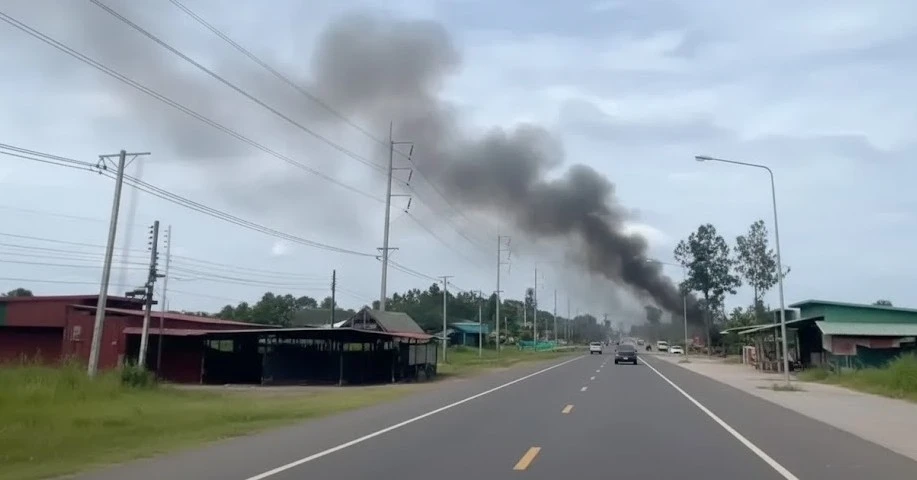
Thailand and Cambodia are at war again. Three Thai soldiers and seven Cambodian civilians died since Monday. Both sides blame each other for starting the violence that has torn apart a fragile ceasefire that US President Donald Trump backed just months ago. The fighting includes airstrikes and rockets, making it the worst violence since July when 48 people were killed and thousands fled their homes during five days of brutal combat.
Trump stepped in back then. He worked with Malaysia and negotiated a deal to stop the bloodshed. By October, he’d overseen the signing of what he called the “Kuala Lumpur peace accord“. Thailand wasn’t having it—they refused to use that name. Instead, they called it a “Joint Declaration by the prime ministers” about outcomes from their meeting in Kuala Lumpur. Two weeks later, Thailand suspended the deal. Come December, guns were firing again across the disputed border.
The real story here? This dispute is ancient. The argument dates back more than a century—to when colonial powers drew the borders between these two nations after the French occupation of Cambodia. Things got officially hostile in 2008. That’s when Cambodia tried to register an 11th Century temple sitting in the disputed area as a Unesco World Heritage Site. Thailand erupted in heated protest.
Since then, sporadic clashes have popped up over the years. Soldiers and civilians on both sides have been killed. Trust? There isn’t any. The latest tensions ramped up in May after a Cambodian soldier died in a clash. That single death plunged bilateral ties to their lowest point in over a decade. Before the first bout of fighting in July, both countries started playing hardball. Cambodia banned imports of fruits and vegetables from Thailand. They stopped importing power and internet services too. Meanwhile, both nations strengthened troop presence in recent weeks along the border.
This Week’s Violence: Who Shot First?
Here’s where it gets messy. The two sides tell completely differing versions of what happened. The Thai army says its troops responded to Cambodian fire in Thailand’s Ubon Ratchathani Province that killed a soldier. They say they had to launch air strikes on military targets along the disputed border. Simple as that, according to Bangkok.
Not so fast, says Phnom Penh’s defence ministry. They claim Thai forces attacked first in Cambodia’s Preah Vihear province. They say they didn’t retaliate—at least not right away. The next day, things got worse. Thailand’s military says Cambodia fired multiple-launch rocket systems at them. They claim bomb-dropping drones and kamikaze drones targeted Thai soldiers, with rockets hitting civilian areas. Thailand confirmed it carried out more airstrikes in response. Cambodia fires back that Thailand was firing indiscriminately into civilian areas in border Pursat Province. Civilians are caught in the crossfire, and nobody’s backing down.
What Really Happened in July
The July mess shows how quickly things spiral. Thailand’s National Security Council—the NSC—claimed that at 07:30 local time (that’s 00:30GMT) on 24 July, Cambodia’s military deployed drones to spy on Thai troops near the border. Shortly afterwards, Cambodian military personnel showed up carrying rocket-propelled grenades. They gathered near the boundary line. Soldiers on the Thai side tried talking things down, shouting across the divide. The NSC spokesman said it was unsuccessful.
Then at 08:20, Cambodian soldiers opened fire, forcing the Thai side to shoot back. That’s Bangkok’s story. Thailand accused Cambodia of bringing out the big guns—deploying heavy weapons like BM-21 rocket launchers and artillery. The shelling caused damage to homes and public facilities, including a hospital and a petrol station on the Thai side of the border.
Cambodia alleged something different entirely. They say Thai soldiers initiated the conflict way earlier—at 06:30—when they violated a prior agreement. According to Phnom Penh, Thai forces were advancing toward a Khmer-Hindu temple and placing barbed wire around its base. Maly Socheata, who’s a spokesperson for Cambodia’s Ministry of National Defence, laid out their timeline. She said a Thai drone was deployed at 07:00. Then Thai forces fired shots into the air at 08:30. At 08:46, Thai soldiers “pre-emptively” opened fire on Cambodian troops, giving them no choice but to exercise their right to self-defence. The Phnom Penh Post newspaper ran her quotes. Socheata accused Thailand of sending in excessive troops and carrying out air strikes on Cambodian territory.
Trump’s Deal That Wasn’t
So what about Trump’s peace plan? It was dead before winter arrived. Thailand paused the agreement in November. Thai Prime Minister Anutin Charnvirakul said the “security threat” hadn’t gone down one bit—”not decreased” at all. Cambodia said they were still in—they remained committed to the terms of the deal. But when fighting broke out again in December, it was clear nobody was following the script.
Bangkok’s foreign minister Sihasak Phuangketkeow told the electronic media bluntly: the ceasefire is “not working”. He said “the ball” is in “Cambodia’s court”. Cambodia’s former prime minister Hun Sen pushed back. He claimed they only returned fire late on Monday because they wanted to “respect the ceasefire”. Trump apparently called on both sides to respect the agreement, according to news agency Reuters. But words don’t stop bullets.
The terms of the agreement signed in October seemed reasonable enough on paper. The two countries agreed to withdraw their heavy weapons from the disputed region. They’d establish an interim observer team to monitor everything. The next step was supposed to include freeing 18 Cambodian soldiers held in Thailand. None of that happened.
Where Does This End?
Where this leads? Nobody knows. It’s unclear right now. In the past, these serious exchanges of fire usually cooled off fast. Things de-escalated relatively quickly before. Back in July, that’s the path everyone expected. Correspondent Jonathan Head thought it would play out the same way—get hot, then followed by a cooldown.
But he warned about something crucial. There’s a real lack of leadership on both sides right now. Neither country has leaders with the strength and confidence needed to pull back from this confrontation. At this moment, nobody wants to be the one who blinks first.
If you’re thinking about travel, the British Foreign Office has clear guidance. They advise against all but essential travel to border areas within 50km of the whole border with Cambodia if you’re heading to Thailand. Same goes the other way—stay away from border areas within 50km of the whole border with Thailand if you’re in Cambodia. The violence that exploded along the border this week shows no signs of stopping. The peace that Trump tried to build through that meeting and signing ceremony feels like ancient history now.