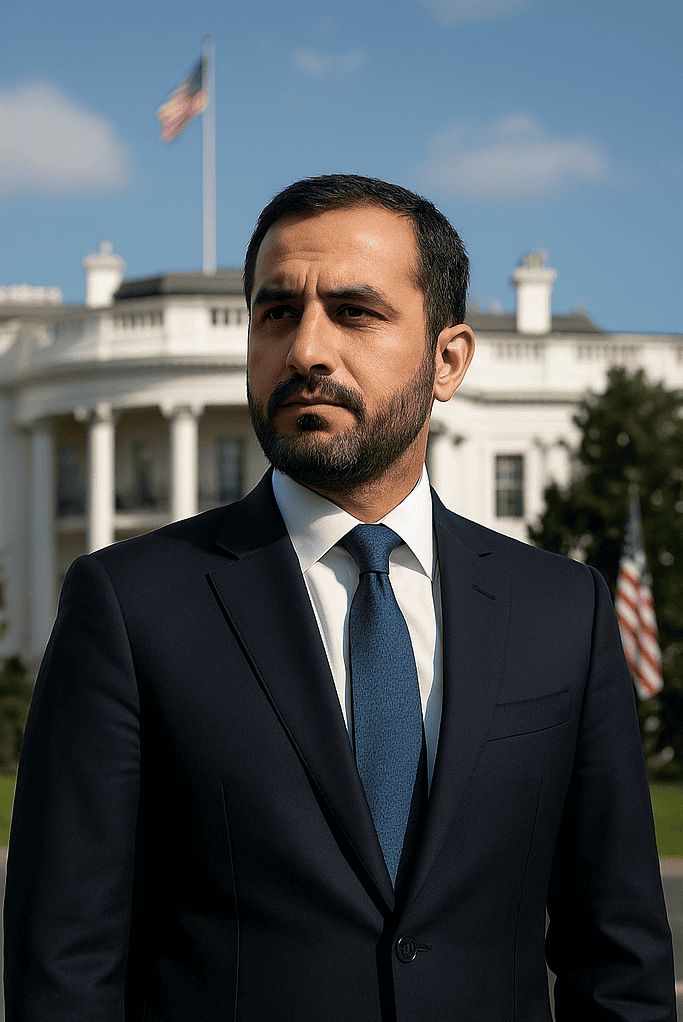
Ahmad al-Sharaa, once an Al-Qaeda-backed rebel army fighter, will meet US President Donald Trump at the White House on Monday in the first ever visit by a Syrian head of state—marking an extraordinary transformation from jihadist to global statesman less than a year after his lightning power grab.
From Battlefield Enemy to White House Guest
The historic visit represents a once-unthinkable encounter between the US commander-in-chief and a man who battling American forces in Iraq during his early twenties. Captured and later released, Al Sharaa crossed into Syria in 2011 and established an insurgent force to fight forces loyal to then-President Bashar Al Assad. This high-profile, high stakes meeting follows Ahmad al-Sharaa’s meeting with Trump in May, a brief meeting brokered by Saudi Crown Prince Mohammed bin Salman, where the American leader hailed the 43-year-old Syrian leader as a “young attractive guy” with a “very strong past.”
The young leader has embarked on his 20th foreign trip since appointing himself president of Syria in January, including a second visit to the United States following his attendance at the United Nations General Assembly in New York in September. His extensive global travel reflects a country’s diplomatic reinvention after decades of isolation under the Assad’s autocratic regime.
The Path from Civil War to Power
After more than a decade of brutal conflict, Syria’s president ended Syria’s long-stalemated civil war by launching surprise offensive that swiftly toppled the 53-year Assad dynasty—an Arab relic of the Cold War. The Assads had aligned Damascus with Moscow since Hafez al-Assad’s first full year in power in 1971, when the Soviet Union established a strategic Mediterranean naval base in the Syrian city of Tartus. Vladimir Putin’s decisive military intervention in 2015 enabled Bashar al-Assad to survive the civil war, though the Russians killed scores of Syrians during their campaign to keep Assad in power.
Following Assad’s fall, the Russians continue to retain control of their military base in Tartus. Last month, al-Sharaa even visited Moscow to meet Putin, demonstrating his careful approach to regional relationships. As he has sought to build ties with Western nations, the leader remains careful not to antagonize Moscow.
Washington’s Strategic Gamble on Syria
Al-Sharaa’s immediate goal in Washington centers on removal of stringent sanctions on Damascus that require congressional approval. He is urging Trump to pressure Israel to halt attacks on Syria and withdraw troops from the south of country. His broader objective, reflected in his diplomatic marathon, aims to reverse Syria’s isolation—a legacy of the previous regime that left the country economically devasted and diplomatically shackled to a narrow axis of allies.
“The US is taking a large gamble on Ahmad al-Sharaa and Syria,” Joshua Landis, director of the Center for Middle East Studies at the University of Oklahoma, told electronic media. “As Ambassador Tom Barrack has stated numerous times, the US has no alternatives. Lebanon is a failed state according to his assessment. Iraq is deeply penetrated by pro-Iranian militias,” he added.
Balancing Act Between East and West
The profound symbolic weight of this White House visit became evident when Al Sharaa played basketball with top US military officials after arriving on Sunday—a stark contrast to his past as enemy combatant joining Islamist insurgents. Once sanctioned for terrorism by the West, he now leads a global diplomatic charm offensive, bolstered by aggressive lobbying from regional heavyweights Saudi Arabia and Turkey, both US allies eager to fill a power and economic vacuum left by Iran and Russia.
“Engaging in a conflict with Russia right now would be too costly with Syria, nor would it be in the country’s interest,” Al-Sharaa told CBS’ “60 Minutes” in an interview aired in October. For the US, Syria represents both a strategic prize and significant risk as neighboring Lebanon spirals into instability and Iraq remains fertile ground for Iran’s proxy militias.
A New Era of Non-Alignment
Despite a clear westward outlook, the former jihadist leader remains adamant about balancing Syria’s foreign policy away from conflict in an increasingly polarized world—a policy followed by several developing nations worldwide. The US President Donald Trump ordered the lifting of some crippling US sanctions after their meeting, though the nation had been firmly aligned with key American foes Russia and Iran for generations.
“In this new era, one doesn’t align completely with any side. We saw that with (Sharaa’s) visit with Putin, who is an active ally with the Assad regime… and you see that with diplomacy on behalf of the Syrian government globally,” Natasha Hall, senior associate at the Center for Strategic and International Studies (CSIS) said. This approach marks a dramatic shift from the Cold War dynamics that shaped Syrian politics since the Soviet Union established its presence in 1971.