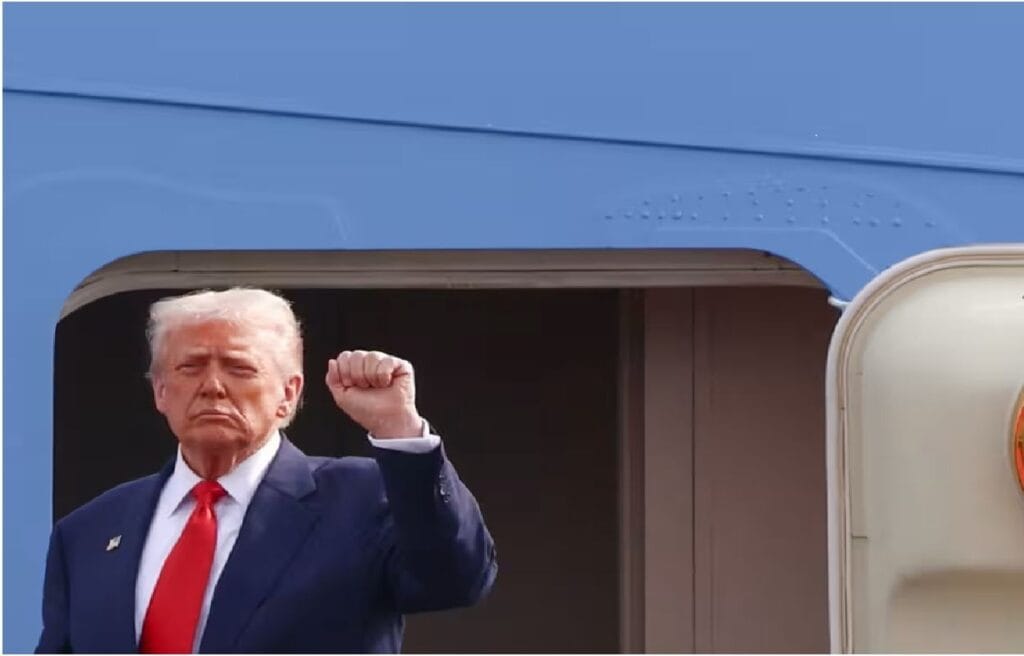
President Donald Trump has told the Pentagon to immediately resume nuclear weapons testing, breaking a pause that’s lasted 33 years. The U.S. President made the surprise announcement Thursday from Marine One before flying to meet Chinese President Xi Jinping for a trade negotiating session in Busan, South Korea. Trump said the U.S. military needs to test so America’s nuclear arsenal stays on an “equal basis” with what other nuclear powers are doing.
It’s the first time Washington has moved to restart testing since 1992. Trump hasn’t said where the nuclear testing sites will be—that’ll be “determined later,” according to officials. But the move has already sparked what one senior Russian lawmaker called a “new era of unpredictability and open confrontation.” The Department of War has been instructed to begin the process right away.
Trump’s push comes as Russia and China have been flexing their nuclear muscles. Russia has the second-largest stockpile in the world with 5,580 nuclear warheads, while China sits a distant third but has been catching up fast.
Beijing has doubled its arsenal in recent years—from around 300 weapons in 2020 to an estimated 600 nuclear weapons this year, according to the Center for Strategic and International Studies, a Washington-based think tank.
U.S. military officials estimate China could hit 1,000 nuclear weapons by 2030. That’s a massive jump in just four or five years. The Arms Control Association says America’s stockpile sits at 5,225 nuclear warheads right now. Trump argues testing is needed and “appropriate” to make sure everything still works. At a September Victory Day parade, China showed off five nuclear capabilities that can reach the continental United States, CSIS noted.
China’s Foreign Ministry pushed back hard, reaffirming its “commitment” to the moratorium on nuclear testing. Beijing said any resumption threatens “global strategic balance and stability.” Russian President Vladimir Putin hasn’t officially responded yet, but Moscow’s been busy with its own weapons demonstrations earlier this week.
On Wednesday, Putin announced a successful test of Poseidon, a nuclear-powered super torpedo that military analysts say is capable of devastating coastal regions and triggering vast radioactive ocean swells. Russia also tested its new Burevestnik cruise missile on October 21—that’s a nuclear-powered, nuclear-capable weapon—and held nuclear launch drills on October 22. When reporters on Air Force One asked Trump about working to end the war in Ukraine, he said he’s “talking to Russia” but Putin keeps “testing missiles instead.”
Reaction in Washington was swift. Representative Dina Titus, a Democrat from Nevada, posted on X that she’s “introducing legislation” to “put a stop” to this. Nevada was home to the former test site where the United States ran contained nuclear tests underground for decades, so people there know what testing means.
Daryl Kimball, director of the Arms Control Association, called Trump “misinformed” and “out of touch.” He said there’s “no technical, military, or political reason” to resume nuclear explosive testing for the first time since the Cold War ended. Experts worry this could “trigger a chain reaction” where U.S. adversaries start testing too, which could “blow apart” the nuclear Non-Proliferation Treaty. The state news agency RIA in Russia quoted that senior Russian lawmaker saying the world is entering a “risky phase.”
The National Nuclear Security Administration handles America’s nuclear infrastructure. Right now, they do flight testing of nuclear-capable missiles—basically making sure the delivery systems work—but they haven’t done nuclear-explosive testing since 1990. That was the last U.S. test. China’s came in 1996, and Russia’s last confirmed test happened in 1990 too.
Getting ready to test again isn’t quick. Technical experts say the process could take 36 months just to get the sites ready. The United States can run computer simulations and what they call subcritical experiments, but those don’t give you the same technical data as an actual explosion. Any test the United States does now would be seen as a “deliberate assertion” of Washington’s strategic power. Trump dismissed the threat to diplomacy, saying U.S. stocks are “well locked up” and functional, and he’d “welcome” denuclearisation talks but wants to modernize first.
The United States opened the nuclear era back in July 1945 with a 20-kiloton atomic bomb test in Alamogordo, New Mexico. Weeks later, America dropped atomic bombs on Hiroshima and Nagasaki in August 1945, which forced Japan to surrender in World War Two. For decades after, all the major nuclear powers except North Korea stopped regular testing in the 1990s.
North Korea conducted its last nuclear test in 2017 after 25 years of weapons development. That gap between tests—33 years for America—became the norm as countries laid out commitments to avoid nuclear-explosive testing. When Trump discussed nuclear arms control back in August and again in February, he said he wanted to “begin discussions” about “imposing limits” on arsenals. He even talked about his “intention to pursue nuclear arms control efforts.” But when asked if other countries should join nuclear disarmament negotiations, Trump responded that it’s “unreasonable” and “unrealistic” to expect two countries with “much smaller” weapons to participate.
What Happens Next in Asia and Beyond
The timing matters because Trump’s heading to meet Xi Jinping in South Korea. Russian moves on testing and the situation in Asia make this announcement even more complicated. Trump repeatedly said that “Russia will test” if America does, and he added he’s been in contact with Moscow about it.
The Pentagon now has to figure out logistics—where to test, how to test, and when to test. Some think Nevada’s former test site makes sense, while others say new locations might be determined later. Whatever happens, rival nuclear powers are watching closely. Trump said on Truth Social that other countries have active testing programs and America can’t fall behind. Whether this actually makes you safer or kicks off a dangerous new arms race depends on who you ask.