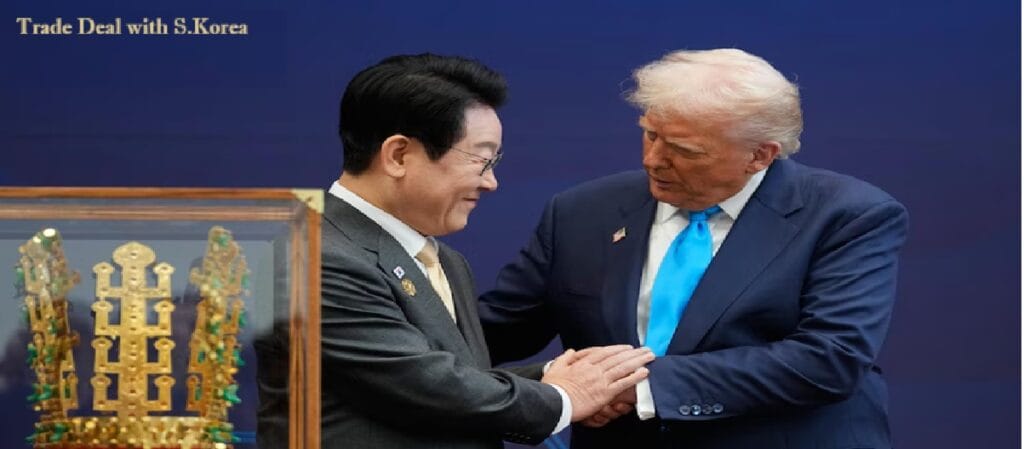
President Trump said early Wednesday the U.S. has “pretty much” reached a trade deal with South Korea. That’s how he put it to reporters — “pretty much” — which isn’t exactly the language of ironclad agreements, but here we are. The President told them they “came to a conclusion” on “a lot of very different items” after what he called a “Great session” with South Korean officials.
So here’s the meat of it. Trump, wrapping up the final leg of his Asia trip, made the announcement while standing alongside South Korean President Lee Jae Myung at the Asian-Pacific Economic Cooperation (APEC) forum in Gyeongju, a city most Americans couldn’t find on a map. According to a White House pool report, they covered multiple sectors. “We did a lot of different things,” Trump said. The White House has not offered any additional information beyond that, which is typical.
But Kim Yong-beom, who’s Lee Jae Myung’s chief of staff, gave reporters actual details. The two countries hammered out an “agreement on details” in their tariff negotiations. According to the Media, the aide confirmed Trump administration’s tariffs on the Asian nation would drop from 25 percent to 15 percent. That’s a massive cut. Not elimination, mind you, but it’s something.
South Korea has been getting hit with a 25 percent import tax on automobiles for over a year now. It’s been making business difficult for South Korean carmakers — specifically Hyundai and Kia, who sell a ton of cars here. Last year those two companies moved 1.4 million vehicles in American showrooms. The 25 percent levy made their pricing completely uncompetitive against Detroit’s big three. Dropping to 15 percent doesn’t solve everything, but it means Hyundai and Kia can actually compete again without taking losses on every sale.
Now there’s this whole other thing that’s been a sticking point between Washington and Seoul for months. Trump’s push for South Korea to directly invest $350 billion into the U.S. Economy. Yeah, you read that right — $350 billion. South Korean leaders have expressed trepidations about that kind of commitment, which is diplomatic speak for “absolutely not.”
They’ve been pushing instead for loans and loan guarantees, which gives them an out if things go sideways. The demand from Trump has been pretty consistent — he wants trading partner nations putting real money into American infrastructure and manufacturing. But asking for $350 billion is like asking your neighbor to co-sign your mortgage, buy you a car, and renovate your kitchen. It’s a lot.
Did this deal actually resolve that issue? Nobody’s saying. The White House hasn’t clarified whether South Korea agreed to the full amount, a partial amount, or just nodded politely and changed the subject. According to people familiar with the talks, both sides made compromises. But what those compromises actually look like remains anybody’s guess. Trump said they reached “conclusion” on “very different items,” which could mean anything or nothing.
If you’re shopping for a car, this matters. Automobiles from South Korea should get cheaper over the next several months as the 15 percent tariff replaces the old 25 percent import tax. Don’t expect dealerships to slash prices tomorrow — these things take time as new inventory cycles through. But eventually, yeah, Hyundai and Kia models should come down a bit.
And it’s not just cars. South Korea ships electronics, appliances, manufacturing equipment, all kinds of stuff that’s been subject to various tariffs. The broader trade deal affects supply chains for smartphones, washing machines, industrial parts. When Trump said they did “different things” across sectors, he wasn’t exaggerating. The agreement touches multiple industries beyond just passenger vehicles.
South Korean companies have been sweating these tariffs for over a year. The 25 percent hit on automobiles alone disrupted planning for both Hyundai and Kia, who’d been considering moving some manufacturing to the U.S. just to dodge the taxes. That would’ve cost South Korean workers jobs. This deal takes some of that pressure off, though 15 percent is still high enough to make domestic production attractive long-term.
Here’s the thing though — the most anticipated meeting of this whole trip is set to take place Thursday with Chinese President Xi Jinping. That’s the heavyweight bout. South Korea? That was the undercard. Trump struck a hopeful tone about a potential trade deal with China ahead of his meeting with Xi. “We’re going to be, I hope, making a deal. I think we’re going to have a deal,” he said, speaking from South Korea after wrapping things up with Lee Jae Myung.
“I think it will be a good deal for both,” Trump added. He keeps using that word — “think” — which doesn’t exactly inspire confidence. But he’s projecting optimism, which is standard operating procedure before major negotiations. “The world is watching, and I think we’ll have something that’s very exciting for everybody,” he told reporters.
The China talks involve way bigger stakes than anything discussed with South Korea. We’re talking hundreds of billions in trade, intellectual property disputes, tech transfers, the whole mess. Whether the momentum from the Seoul deal actually translates to progress with Beijing is the real question. Trade watchers at the APEC forum are skeptical. China’s economy is ten times the size of South Korea’s. Xi has way more leverage than Lee Jae Myung ever will.
Look, dropping tariffs from 25 percent to 15 percent is objectively good for South Korean exporters. It gives companies like Hyundai and Kia room to breathe. But calling this a comprehensive trade deal might be overselling it. The $350 billion investment question is still hanging out there unresolved. The details beyond tariff numbers remain vague. And Trump’s characterization of “pretty much” reaching a deal suggests there’s still loose ends.
What this really does is give Trump something concrete to point to as he heads into the tougher China negotiations on Thursday. He can say he successfully negotiated with a trading partner, showed flexibility by coming down from 25 percent, and got South Korea to the table on investment questions even if they didn’t fully commit. That’s the political value here — demonstrating he can close deals before attempting the much harder one with Xi.
For everybody watching this Asia trip unfold, the Seoul agreement is interesting but not game-changing. The real test comes when President Donald Trump sits down with Xi Jinping and tries to apply the same approach to a country with considerably more economic muscle and less incentive to compromise. That’s when we’ll see if this negotiating strategy actually works or if South Korea was just the easy practice round.