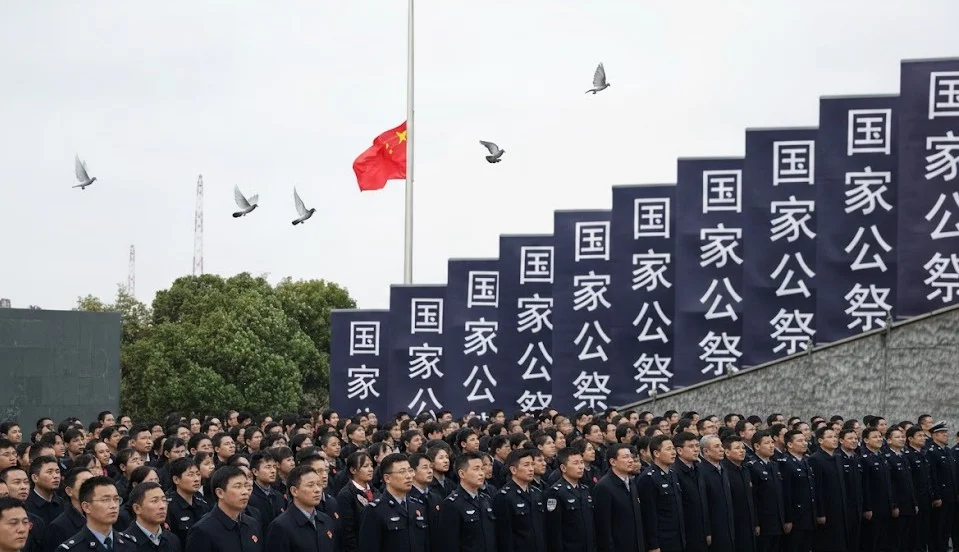
Chinese President Xi Jinping didn’t show up Saturday for China’s annual Nanjing Massacre memorial. Pretty notable timing given Beijing and Tokyo are barely speaking to each other right now over Taiwan. China held the ceremony anyway at the national memorial centre in Nanjing, but kept everything unusually quiet.
Prime Minister Sanae Takaichi said something last month that set Beijing off. She floated the idea that if China attacks Taiwan, Japan might have to respond militarily. Tokyo usually avoids being that specific. Her comments about a hypothetical Chinese attack potentially triggering a military response broke years of careful diplomatic language.
China and Japan can’t seem to agree on much when it comes to World War II history. Beijing says Japanese troops killed 300,000 people during the 1937 Nanjing Massacre. A post-World War II Allied tribunal put the death toll at 142,000. Conservative politicians and scholars in Japan argue the massacre didn’t happen at all. This disagreement isn’t going away.
Party Official Ran Saturday’s Event
Shi Taifeng handled the memorial instead of Xi. He heads the ruling Communist Party’s powerful organisation department, so he’s not exactly a nobody. Shi referenced a speech Xi gave at a military parade in Beijing last September marking 80 years since World War II ended. But Shi’s tone was surprisingly measured compared to what other government officials have been saying lately.
History has fully demonstrated that the Chinese nation is a great nation that fears no power and stands on its own feet, Shi told the crowd. He didn’t name Takaichi directly. Just alluded to previous claims that she wants to revive Japanese militarism. Attempts to challenge the postwar international order or undermine world peace and stability won’t be tolerated by peace-loving peoples around the world, he said. Doomed to fail.
Whole thing took less than half an hour. Doves flew over the site afterward. Police officers and school children made up most of the audience standing in front of the memorial. Quick, controlled, deliberately low-key.
Xi Hasn’t Attended Since 2017
Xi last attended in person back in 2017, though he didn’t deliver public remarks that year either. When China marked its first national memorial day for the massacre in 2014, Xi spoke and called on both countries to set aside hatred. Don’t let the minority who led us to war affect relations now, he said then.
State Council Information Office handles questions from foreign media about the central government. They didn’t immediately respond when asked about Xi’s absence. Not surprising given how sensitive everything is right now between Beijing and Tokyo.
Military Posted Aggressive Image Same Day
While civilian officials kept things restrained, the People’s Liberation Army went a different direction entirely. Eastern Theatre Command posted a graphic picture on social media accounts. Showed a large bloody sword – the type many Chinese soldiers used during the war – chopping off a skeleton’s head wearing a Japanese army cap.
Caption read: “For nearly 1,000 years, the eastern dwarves have brought calamity; the sea of blood and deep hatred are still before our very eyes.” Eastern dwarves is an old expression for Japan. Deeply insulting. Someone in the PLA decided posting that during this week made sense. Mixed messages from different parts of Beijing.
Taiwan Sits at Center of Current Fight
Chinese-claimed Taiwan drives most of this tension. Tokyo has always been vague about what Japan could actually do if China moved on the island. Takaichi changed that by saying it out loud. Put something concrete on the table instead of strategic ambiguity.
Beijing sees that as crossing a major line. Taiwan isn’t negotiable from their perspective. When Takaichi talked about her hypothetical scenario, she touched China’s rawest nerve. Reunification will happen eventually, Beijing insists, by force if necessary.
What Japanese troops did in Nanjing in 1937 still matters today. China uses it to question whether Japan really moved on from its imperial past. When Shi warned about attempts to revive militarism being doomed to fail, he meant now, not just history.
Death Toll Dispute Feeds Political Arguments
China says 300,000 people died. Allied tribunal said 142,000. Huge gap there. Both numbers represent mass atrocities, but the difference fuels arguments about truth and credibility. Conservative voices in Japan who deny what took place point to these discrepancies. Chinese officials say Japan wants to whitewash history and challenge established war facts.
Not really about getting history right anymore. More about who controls the narrative going forward. Shi talked about how history has proven certain lessons and will continue to prove them. Which history though? Whose version? Matters when deciding if Takaichi represents dangerous thinking or reasonable defense planning.
Beijing kept the official memorial ceremony restrained. Let the PLA vent on social media instead. Tokyo has a Prime Minister willing to say things previous leaders only whispered. Xi staying away from an event he used to attend says plenty on its own.