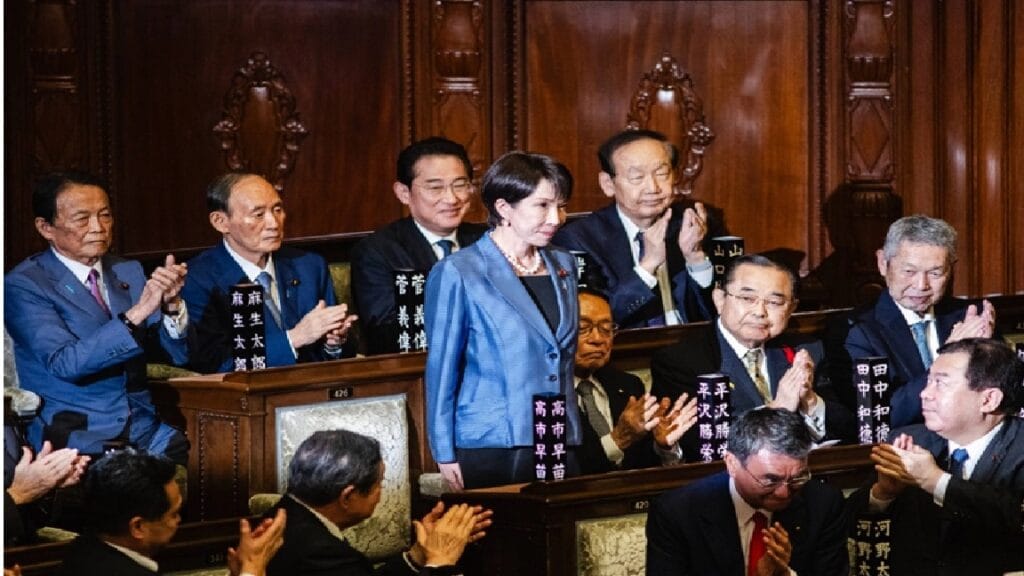
Sanae Takaichi has broken through one of Asia’s highest glass ceilings, becoming Japan’s first female prime minister after parliament handed the 64-year-old conservative leader a decisive victory on Monday. She pulled in 237 votes in the Lower House and 125 in the Upper House, giving her the mandate to lead the ruling Liberal Democratic Party (LDP) at what might be the worst possible time. The world’s fourth-largest economy is grappling with rising cost-of-living pressures that have left ordinary people genuinely angry, and Takaichi takes over knowing the public won’t give her much grace.
This makes her the fourth PM in just five years – a revolving door that speaks volumes about Japan’s political instability. Her predecessors couldn’t hang on, their terms cut short by plunging ratings and the kind of scandals that erode trust faster than anything else. Takaichi defeated four men in the brutal LDP race back in early October, but getting the top job looked impossible when the long-time coalition partner Komeito party withdrew support. What saved her was a last-minute deal hammered out on Monday night with the right-leaning Japan Innovation Party (JIP) – people know them as Ishin. She won’t face voters again until 2028, which gives her breathing room but also raises the stakes.
They call her the “Iron Lady,” and Takaichi wears that nickname with pride. Her admiration for late former British PM Margaret Thatcher isn’t subtle – she’s studied Thatcher’s playbook and adopted the same uncompromising approach. As a staunch conservative with decades embedded in Japanese politics, the LDP leader is hardly new to the game. She’s held several ministerial roles across her career, always operating as a known ally of late former PM Shinzo Abe. She’d run for the PM job before and failed, but this time circumstances aligned after Shigeru Ishiba resigned in disgrace following major losses in midterm elections.
Her political views don’t leave much room for interpretation – they’re deeply traditional and firmly planted in right-wing politics that lean nationalist. She’s maintained opposition to same-sex marriage and won’t budge on a growing demand to allow married women to keep their maiden surnames. That’s made some young people, especially women, deeply sceptical. “Everyone’s thinking, ‘Wow, she’s the first female prime minister in Japanese history – what a great opportunity for women’s empowerment’,” said 21-year-old student Ayda Ogura. “But when you actually look into what she believes and where she stands politically, you realise some of these things are very traditional. She’s not really about creating structural change – she rather perpetuates the patriarchal system we’re trying to escape.”
The new prime minister faces serious domestic challenges, and they’re not abstract policy debates – they’re hitting people’s wallets directly. Prices continue to soar across Japan, and the frustrated public is running out of patience during this uncertain period. There’s an ongoing rice shortage that’s become almost symbolic – rice, for example, is a Japanese staple, and when record prices make it unaffordable, that resulted in genuine anger on the streets. Takaichi knows she must turn her attention to rebuilding trust, which collapsed after the LDP – a party that’s governed for the past seven decades – lost its majority in the lower house for the first time in 15 years under Ishiba.
Then things got worse. The party lost its majority in the upper house in July, amid genuine anger after a fundraising scandal exposed how disconnected politicians had become. In electing Takaichi, the LDP hoped to win back conservative voters who’d gravitated toward the far-right Sanseito party, completely disillusioned with the usual options. During her recent campaign, she proposed expanded hospital services for women’s health and promised household workers greater recognition. Still, critics argue these are band-aids, not the fundamental reforms needed. She has a major task ahead of her to prove she’s more than just another conservative placeholder.
Meanwhile, aside from domestic headaches, Takaichi faces tricky relationships abroad that could define her tenure. South Korea, which had finally started to mend historically delicate ties with Japan, is now wary again because of her nationalist positions. Like some of her predecessors, including Abe, she’s seen as genuinely hawkish when it comes to dealing with an increasingly powerful China. Rather than taking a softer approach, the new PM plans to maintain a firm defence stance that could escalate regional tensions.
The most important relationship, though, remains with the US, and there’s a real test around the corner – a high-stakes meeting with US President Donald Trump next week. While both sides have reached a tariff deal that looks good on paper, Trump’s past comments questioning the value of the security treaty and demanding Tokyo pay more for defence have raised concerns that won’t disappear with one handshake. Takaichi must navigate these diplomatic minefields alongside an unpredictable administration, and at her age (though she’d hate this being mentioned), experience in diplomacy actually counts for something.
Historic Appointments and Market Response
Local media are reporting that Takaichi plans to appoint Satsuki Katayama as finance minister, which would mark yet another historic breakthrough for a woman in Japan’s stubbornly male powerful government. Like Takaichi, Katayama is too a protege of Abe, which suggests we’ll see continuity rather than revolution in economic policy. This deal between an opposition party and the ruling coalition signals a new moment for Japanese governance, though nobody’s betting on long-term stability just yet.
There’s genuine concern about Japan’s rising debt and lacklustre growth that’s been worrying investors for months, but Takaichi’s win seemed to offer a dose of optimism to the markets, at least initially. The clear majority she won suggests some stability after months of uncertainty. What comes next, though, will show whether this historic Monday actually means anything or if it’s simply one more twist in Japan’s ongoing political drama. The significance of having the first woman to hold this office isn’t lost on anyone, but whether she can actually deliver change – or even wants to – remains the real question.