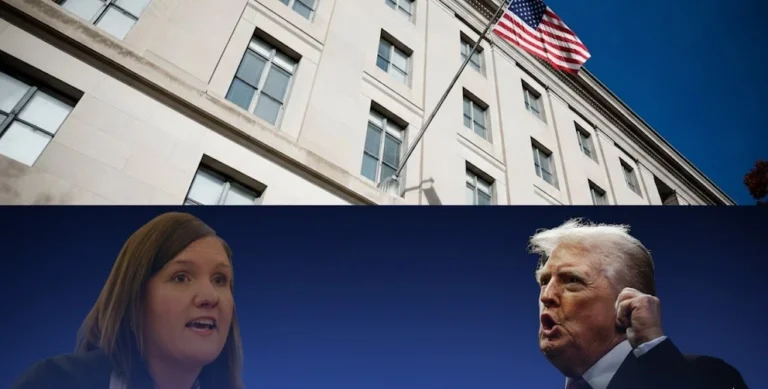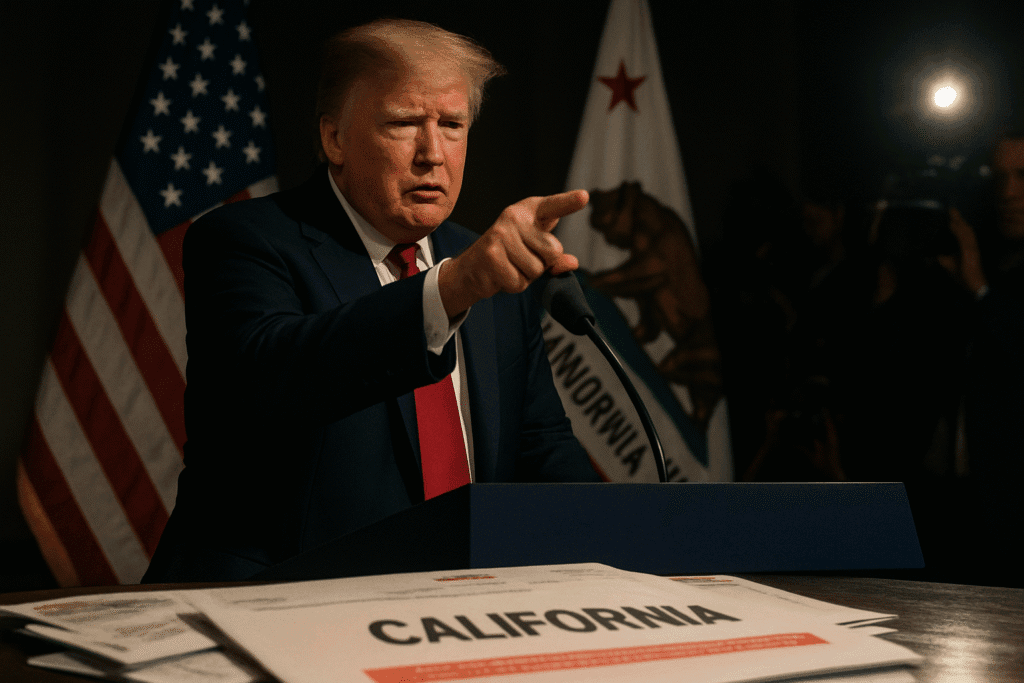
President Trump went on the offensive Tuesday, declaring he’d pursue legal action over mail-in ballots cast in California as voters weighed in on a controversial redistricting measure. The announcement came with characteristic fire, slamming what he described as a fundamentally rigged system designed to benefit one party at the expense of another.
Trump pulled no punches in his Truth Social message, where he wrote that the Unconstitutional Redistricting Vote in California represents a “GIANT SCAM.” According to the president, the entire process—particularly the voting itself—has been structured to exclude Republicans from meaningful participation. “Mail-In Ballots,” he argued, create a situation where his party gets “Shut Out” of fair representation.
His post carried a warning that felt more like a promise: everything about these mail-in ballots now sits under “very serious legal and criminal review.” Then came those two words that have become his signature: “STAY TUNED!” The White House hasn’t offered much clarification about what concrete steps might follow, leaving political observers to wonder whether courts will soon be flooded with challenges to California’s electoral procedures.
Golden State voters showed up Tuesday for consideration of Proposition 50, and honestly, most people outside California probably don’t realize how much this matters to them too. This state’s redistricting measure isn’t some local issue that stays contained within one state’s borders. If the measure wins—and recent polling suggestion indicates that’s the likely outcome—California will redraw its congressional maps in ways that ripple through Washington’s power structure.
Let’s break down what that actually means for you. Democrats already dominate California politics with their supermajority, but this could hand them a potentially massive five-seat advantage in the House of Representatives. When congressional majorities sometimes come down to single-digit seat differences, five seats can mean the difference between passing legislation or watching it die in committee. The state’s congressional districts would get their first major reshaping in years, fundamentally altering how America’s most populous state influences national policy.
On the flip side, if Proposition 50 loses, everything freezes in place until the 2030 census forces mandatory redistricting. That’s nearly a decade of the status quo, which explains why both parties have thrown so much energy and money into this fight.
Trump didn’t suddenly develop concerns about mail-in voting yesterday. He’s been a frequent critic going back years, consistently pushing repeated unproven claims of voter fraud that he insists are fundamentally associated with voters casting ballots by mail. His core argument hasn’t changed much: Trump claimed he only suffered a loss in 2020 because states implemented expanded mail-in voting as a result of the COVID-19 pandemic.
The thing is, election officials from both parties, along with numerous independent audits and court reviews, haven’t found evidence supporting these fraud claims. But Trump remains unmoved, and California represents everything he thinks is wrong with modern American elections. The entire process of how voters submit their ballots through the postal system strikes him as inherently suspect, even though Americans have been casting votes this way for decades without controversy.
What was once a boring administrative detail—how absentee ballots get processed—has become one of the most divisive issues in American politics. Military members stationed overseas have always voted by mail. So have elderly citizens with mobility issues. Now it’s a culture war flashpoint.
When Trump came back to power, returning to the White House after his victory, he moved quickly on this issue. The executive order he signed in March wasn’t subtle about its intentions. Among other things, it directed Attorney General Pam Bondi to actively go after states that count absentee or mail-in ballots received after Election Day.
Here’s where it gets interesting for state officials trying to do their jobs. Most states count mail-in or absentee ballots without issue as long as they’re postmarked by Election Day—that’s been standard operating procedure forever. A soldier serving in Germany mails their ballot on November 3rd, it arrives November 6th, and it gets counted. Makes sense, right? But Trump’s order challenges that whole framework. States that don’t comply face having their federal funding withdrawn, which for most states means billions of dollars suddenly disappearing from budgets.
Then in August, Trump threatened something even more dramatic. He floated the idea he’d issue an executive order to essentially eliminate mail-in voting across the entire country. He also went after what he called “seriously controversial voting machines,” making these comments in a Truth Social post that immediately generated intense debate about presidential power versus state authority.
The following month brought one of the stranger chapters in this ongoing saga. President Donald Trump suggested his decision to move Space Command’s headquarters away from Colorado Springs, Colo. to Huntsville, Ala. was directly tied to the state’s mail-in voting laws. Think about that for a second—a major military installation’s location determined by state voting procedures.
“The problem I have with Colorado,” Trump explained, “one of the big problems, they do mail-in voting. They do all mail-in voting. So they have automatically crooked elections.” His logic continued: when any state embraces mail-in voting, “that means they want dishonest elections, because that’s what that means.” He wrapped up by declaring Colorado runs “a very corrupt voting system.”
Colorado lost a major federal facility — not over strategic military priorities, infrastructure capability, or operational readiness. It lost Space Command because Trump objects to how its residents cast their votes. That sets a striking precedent: wielding military installations as political leverage to strong-arm states over how they run their elections.