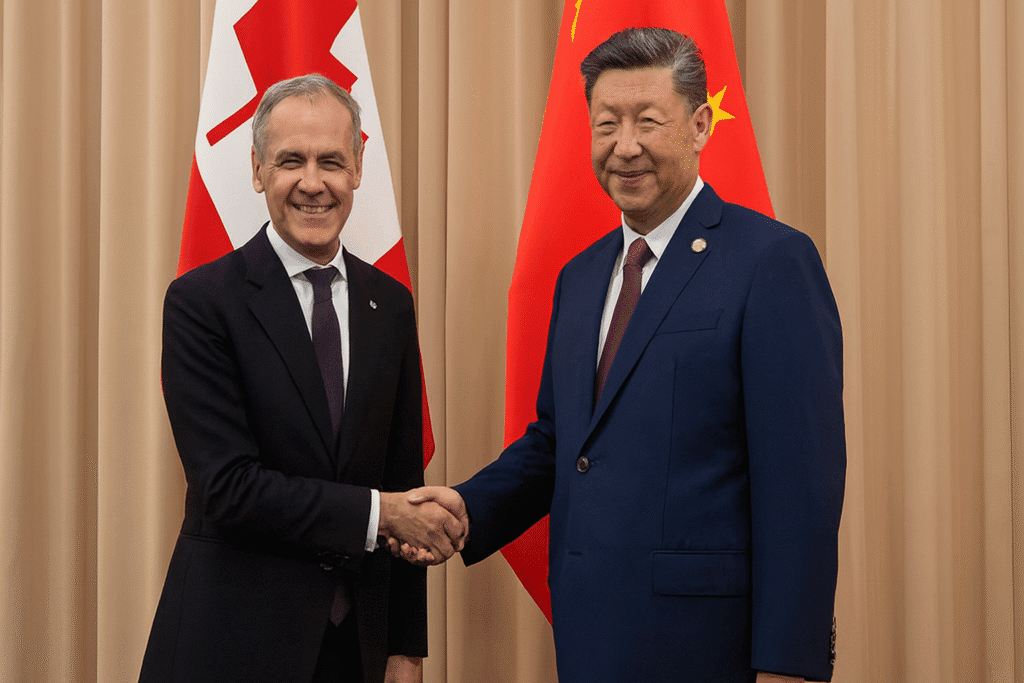
President Donald Trump’s escalating trade war has forced Canada into an unprecedented diplomatic pivot, with Prime Minister Mark Carney and Chinese leader Xi Jinping shaking hands for the first time in eight years—a move that signals Ottawa’s desperate search for economic alternatives as Washington emerges as its biggest threat.
The unthinkable is happening. Canadian and Chinese leaders stood side by side, grinning at the Asia-Pacific Economic Co-operation summit in South Korea last month, marking a dramatic turning point in relations between two countries whose ties completely cratered in 2018. That’s when Canadian police arrested Meng Wanzhou, a technology executive, in Vancouver on US fraud charges, triggering Beijing’s immediate retaliation—locking up Canadians Michael Kovrig and Michael Spavor on spying charges that Canada slammed as bogus. The diplomatic tussle created deep mistrust between Ottawa and Beijing, with the Canadians spending nearly three years in Chinese detention before being released when the extradition request was dropped.
Trump’s trade war has created what experts call a vulnerable moment for Canada, and China isn’t missing the opportunity. Michael Kovrig, now a senior adviser for the Crisis Group after his release, warns that China wants to drive a “big wedge” between Canada and the US. “The last thing China wants is a strong, united West trying to constrain China’s global ambitions,” he explains.
The tide began turning early last month when Canada’s top diplomat Anita Anand visited Beijing to meet her counterpart Wang Yi. That ministerial visit paved the way for the 40-minute meeting between Carney and Xi on the sidelines of the summit—the first time the two countries’ leaders had met in eight years. According to a Canadian statement, both sides pledged to improve ties and collaborate on trade, with Carney planning to visit Xi in China. Beijing has since reinstated Canada to its approved travel list for tour groups, a move expected to boost tourism for the North American country.
Economic Incentives Drive the Shift
Both sides share a shared problem with the US, creating powerful economic incentives to get along. Last year, Canada slapped a 100% tax on Chinese electric vehicles in conjunction with the US to protect its domestic market from what it cited as unfair competition from state-subsidized Chinese carmakers. China fired back in March, announcing retaliatory tariffs on Canadian agricultural and food products, including a 100% levy on canola oil and meal. By August, Beijing added a devastating 75.8% tariff on canola seed, effectively shutting down Canada’s second-largest market for the crop and hurting Canadian farmers across the nation.
Meanwhile, the US has increasingly ramped up its economic war on its northern neighbor. Trade negotiations between Trump and Carney appeared to be making progress when Trump abruptly halted talks again last month after a controversial anti-tariff ad by the government of Ontario, Canada’s most populous province. With the US now emerging as Canada’s biggest economic threat, Canada can no longer afford to be in a trade war with the world’s two largest economies. That’s made China a more appealing prospect.
Canada’s tone towards China has taken a “180-degree shift” in recent months”, says Lynette Ong, director of the China Governance Lab at the University of Toronto’s Munk School of Global Affairs. Public sentiment seems to agree. Recent opinion polling found Canadians are more likely to say the US (46%) should be treated as a threat than China (34%)—though most Canadians still view China negatively. “The clear strategy here is when you’re shut out of your major export market and being subject to pretty punitive tariffs in some key sectors… you’re going to be looking for other dance partners,” explains Fen Hampson, chancellor’s professor at Carleton University in the Canadian capital.
Still, Ottawa risks isolating Washington further if it aligns itself with Beijing, Hampson warns. “It’s a bit of a Rubik’s cube here that leadership is dealing with.” The delicate balancing act requires Canada to maintain its closest allies relationship with the US while exploring opportunities with its longtime foe to find common ground.
China’s Strategic Opening
Facing pressure to boost China’s exports, Xi has warmed to Western nations and other US allies in a way he hasn’t in the past eight years, Ong notes. He’s become “a lot more relaxed,” even able to joke with the president of South Korea about backdoor technology—referring to a rare candid moment between Xi and President Lee Jae Myung at APEC last month. Since Trump returned to the White House, China has taken a “more conciliatory, flexible approach” to its foreign policy,” says Brian Wong, an assistant professor at the University of Hong Kong.
Chinese officials have been “adopting postures” that are propelled not just by a desire to show strength, but also to build goodwill amongst long-standing partners or allies to the US who may feel alienated by Washington’s erratic, capricious, and at times duplicitous moves in recent months. Beijing will have been watching developments between Ottawa and Washington closely and recognized that the antagonism between the two long-standing economic partners could be “more than skin deep,” Wong adds.
While some experts see opportunities for Canada to re-engage China, others urge caution. There may be a way for Canada to serve its interests by acting as a “sort of middle ground” between the US and China, Ong suggests. “There are certain things that Canada is well-positioned to do because of its geographical position,” she adds. Xi’s public embrace of Carney will have sent a message to the top-down Chinese bureaucracy that it’s okay to do business with Canada again, Kovrig notes, adding it’s no longer in China’s interest for Canada to be in the “doghouse.”
But any cooperation will come with conditions, Kovrig warns. “China is trying to condition access” to senior leaders and political cooperation… on respecting what China calls its “core interests,” he explains, including on Taiwan, the self-governing island Beijing claims as its own. China will also want to silence any criticism from Canada over its human rights record—a price that could prove too high for Ottawa to pay while maintaining its values.
What This Means for the Future
Hampson says this should be a message to the White House to “tread carefully” and consider the longer-term geopolitical implications of its trade policy. “If you stop recognizing your economic relationships with your closest neighbors and trading partners, don’t be surprised if they start hedging their bets by doing business and striking deals with your principal geopolitical rival,” he cautions. The year ago scenario that seemed unfathomable—Canadian and Chinese leaders standing together, ties being restored despite the soured relationship—is now reality, fundamentally reshaping power dynamics in the region.